Wednesday, April 26, 2017

Commentary on Meditations: B2.11

You may leave this life at any moment: have this possibility in your mind in all that you do or say or think. Now departure from the world of men is nothing to fear, if gods exist: because they would not involve you in any harm. If they do not exist, or if they have no care for humankind, then what is life to me in a world devoid of gods, or devoid of providence? But they do exist, and they do care for humankind: and they have put it absolutely in man's power to avoid falling into the true kinds of harm. If there were anything harmful in the rest of experience, they would have provided for that too, to make it in everyone's power to avoid falling into it; and if something cannot make a human being worse, how could it make his life a worse life? The nature of the Whole would not have been blind to this, either through ignorance or with knowledge unaccompanied by the power to prevent and put right. Nor would it have made so great an error, through lack of power or skill, as to have good and bad falling indiscriminately, on good and bad people alike. Yes, death and life, fame and ignominy, pain and pleasure, wealth and poverty - all these come to good and bad alike, but they are not in themselves either right or wrong: neither then are they inherent good or evil.

Sitting squarely in the arena of the discipline of desire is the practice called premeditatio malorum (do a search on that term for some excellent articles).  In modern English it means pre-meditating the worst possible things that could happen to you - including your death.  Visualizing this strong negative emotion does a few things for you.

First, if you can anticipate "bad" things that may happen to you today (including death), it helps to soften the blow when they actually happen.  This helps to alleviate internal suffering you may experience.  For example, on a podcast I listened to today (#2 - The Nature of Human Suffering), Noah Rasheta described a scenario of going out into the woods at night and encountering someone jumping out from behind a tree dressed in a bear costume.  You'd be very frightened and shocked and completely surprised if that happened.  But suppose before you go into the woods, someone warns you that there is a person out there dressed in a bear costume waiting to jump out at you.  In that case, you might be a bit more prepared and your reaction might not be as severe.

Secondly, practicing premeditatio malorum will help you accept the greater, universal course of events, of which you are a part.  It helps you be humble and accept that you are not the center of the universe - that there are greater things at play.  It helps you amor fati or love your fate or lot in life.  Mike Tyson once tweeted, "If you’re not humble in this world, then the world will throw humbleness upon you."  His life is certainly an example of that idea.

Thirdly, it helps you prepare and plan for the unexpected.  Let's say you anticipate yourself being involved in a car accident today and you become paralyzed for the rest of your life.  In this premortem, perhaps you can plan for accepting how your life will change and be different; how you will need to rely on family to care for you and how you will psychologically cope and how you will need to redefine your purpose in life.  In another way, this premortem will help you accept and be able to cope with much less severe unexpected events - such as your meeting or basketball game being cancelled or a traffic wreck on the freeway which causes your commute to be delayed by 3 hours.

In this meditation by Marcus, he contemplates his death and how it really isn't so bad. He also emphasizes that death, like fame, fortune, pain, pleasure and poverty, should not be viewed as good or bad; but rather as indifferent. Life is not about these things. Rather, life is about responding and living virtuously to each of these indifferent events. For every event, you have the choice to respond with courage, or justice, or temperance, or wisdom.

Monday, April 24, 2017

Commentary on Meditations: B2.10

In his comparative ranking of sins, applying philosophy to the common man's distinctions, Theophrastus says that offences of lust are graver than those of anger: because it is clearly some sort of pain and involuntary spasm which drives the angry man to abandon reason, whereas the lust-led offender has given in to pleasure and seems somehow more abandoned and less manly in his wrongdoing. Rightly, then, and like a true philosopher, Theophrastus said that greater censure attaches to an offence committed under the influence of pleasure than to one under the influence of pain. And in general the one is more like an injured party, forced to anger by the pain of provocation: whereas the other is his own source of the impulse to wrong, driven to what he does by lust.

There is not much to this passage other than to show that from Marcus' mind, as well as other Stoics, there is a distinction between various offenses in virtue.

In the case of a violation of virtue involving pleasure and anger, Marcus held to the view that violations involving pleasure were worse than anger, due to the fact that in the case of pleasure, one has more control over the situation than anger.

This distinction is allowed so that people practicing Stoicism can track progress on their personal journey. While a person remains underwater, to know that they are closer to the surface might encourage them to keep swimming to the air. 

For further reading on this passage, see p.57-58 Inner Citadel

Friday, April 21, 2017

Commentary on Meditations: B2.7-9

7. Do externals tend to distract you? Then give yourself the space to learn some further good lesson, and stop your wandering. That done, you must guard against the other sort of drift. Those who are dead to life and have no aim for the direction of every impulse and, more widely, every thought are drivellers in deed as well as word.

8. Failure to read what is happening in another's soul is not easily seen as a cause of unhappiness: but those who fail to attend to the motions of their own soul are necessarily unhappy.

9. Always remember these things: what the nature of the Whole is, what my own nature is, the relation of this nature to that, what kind of part it is of what kind of Whole; and that there is no one who can prevent you keeping all that you say and do in accordance with that nature, of which you are a part.

In order to exercise the discipline of assent, you must circumscribe yourself. What does that mean? It means you must define and clearly make a limit or boundary around your mental state. Marcus Aurelius uses the imagery of a citadel. If your mind is in that citadel, you control what is in it, which is your attitude and response to events, and everything outside of that citadel is not up to you.

In the domain of things not up to you are other people, the past, the future, and even those involuntary emotions that happen to our body. Another thing not up to us is the course of events or the course of destiny (see pp 115-118 Inner Citadel).

To elaborate on this analogy, think of a citadel and then imagine looking at it from above and seeing various domains of things not up to use. This image would look similar to a target.

When it comes to the discipline of assent, you must constantly determine what is up to you and what is not up to you. Furthermore, you must make an effort to view events and externals objectively, that is, to not automatically add your opinion on top of events. Let there be a pause or space between the external event and you forming an opinion about it. Another term of this is mindfulness.

In chapter 7, Marcus cautions against distractions and drift. To counter this, give yourself space. Give yourself time to think before reacting or having a strong negative or positive emotion.

In chapter 8, we must observe what is happening in our own soul. If we don't observe what is happening in our own souls, we will be swept up in external events and we lose our control or our self-discipline.

Lastly, in chapter 9, he is advising that we should constantly be mindful of our position in relation to the whole. This is a theme that emerges repeatedly in his Meditations. We are a speck in the Universe and we ultimately have control over our attitude and how we perceive the world.

How do you become more mindful? How do you expand that space between event and response?

You meditate. It's as plain and simple as that.

How do you meditate?

There are lots of options and ways. Regardless the method, what you are trying to aim for is the ability to pause and reserve judgement on things and events. You want to get away from the automatic response. It is not easy.

Some will sit in solitude and simply observe their thoughts. Others will concentrate on a single thought and not let their mind wander. But again, no one way is correct. Rather if the way you meditate helps you have greater control over that pause, then it is working.

Wednesday, April 19, 2017

Commentary on Meditations: B2.4-6

4. Remember how long you have been putting this off, how many times you have been given a period of grace by the gods and not used it. It is high time now for you to understand the universe of which you are a part, and the governor of that universe of whom you constitute an emanation: and that there is a limit circumscribed to your time - if you do not use it to clear away your clouds, it will be gone, and you will be gone, and the opportunity will not return.

5. Every hour of the day give vigorous attention, as a Roman and as a man, to the performance of the task in hand with precise analysis, with unaffected dignity, with human sympathy, with dispassionate justice - and to vacating your mind from all its other thoughts. And you will achieve this vacation if you perform each action as if it were the last of your life: freed, that is, from all lack of aim, from all passion-led deviation from the ordinance of reason, from pretence, from love of self, from dissatisfaction with what fate has dealt you. You see how few things a man needs to master for the settled flow of a godfearing life. The gods themselves ask nothing more of one who keeps these observances.

6. Self-harm, my soul, you are doing self-harm: and you will have no more opportunity for self-respect. Life for each of us is a mere moment, and this life of yours is nearly over, while you still show yourself no honour, but let your own welfare depend on other people's souls.

Procrastination - that thief of time and will.  Sometimes, I have procrastinated a certain task and I am glad I did, due to the fact that the task was no longer required or due to the fact the scope or requirement changed.  And my procrastination saved me time.  However, in the context of what Marcus is saying in Book 2, verses 4-6, he is talking about grander, more important things.  He is referring to life; and learning the lessons of life and not wasting it away.  He is talking about amor fati and being willing to accept the universal forces in action.  Furthermore, he is trying to convey the seriousness of the present - the NOW.

Neither the past nor the future are 'up to us.'  The only thing 'up to us' is the present.  And if we waste away the present watching TV, flipping through social media, eating food and lazing around, as opposed to being mindful, helping others, acting logically, then we will have not only wasted the present, but squandered all future present moments.

The purpose of thinking that we may die at any moment and that we should "perform each action as if it were the last" of our life, is to help us appreciate the vast importance of NOW.

To finish, let me quote Hadot on this point (p. 135 The Inner Citadel):
The thought of death confers seriousness, infinite value, and splendor to every present instant of life. "To perform each of life's actions as if it were the last" means to live the present instant with such intensity and such love that, in a sense, an entire lifetime is contained and completed within it. 
Most people are not alive, because they do not live in the present, but are always outside of themselves, alienated, and dragged backwards and forwards by the past and by the present. They do not know that the present is the only point at which they are truly themselves and free. The present is the only point which, thanks to our action and our consciousness, gives us access to the totality of the world.

Monday, April 17, 2017

Commentary on Meditations: B2:3

The works of the gods are full of providence. The works of Fortune are not independent of Nature or the spinning and weaving together of the threads governed by Providence. All things flow from that world: and further factors are necessity and the benefit of the whole universe, of which you are a part. Now every part of nature benefits from that which is brought by the nature of the Whole and all which preserves that nature: and the order of the universe is preserved equally by the changes in the elements and the changes in their compounds. Let this be enough for you, and your constant doctrine. And give up your thirst for books, so that you do not die a grouch, but in true grace and heartfelt gratitude to the gods.

The discipline of desire consists of two views as outlined by Hadot:

First "in refusing to desire anything other than what is willed by the Nature of the All" and second "in wanting to do that which my own nature wants me to do." (see p. 129).

The passage above (book 2, verse 2) in Meditations alludes to the first type of view - that is we ought to desire what the Universe / Zeus / God desires.

This world and universe, of which we are a part, was designed well.  It functions as it ought.  However, it is humanity's negative perception which causes us to view it in a negative light.

A farmer, for example, may view the sunlight as good and beneficial for his crops.  Water is also viewed as beneficial.  However, too much sun and not enough water can be viewed is not good for the farmer.  The farmer ought to use his reason to understand the risks and take appropriate action.  But the abundance of sun and the lack of water are forces that naturally occur and are not inherently good or bad, rather, they just are.

Practically speaking, the sooner you understand the true nature of the situation, the better off you will be in finding contentment and not spending energy or effort being angry at something that is entirely out of your control.  In summary, love what the Universe / Zeus / God has sent your way.

Friday, April 14, 2017

Commentary on Meditations: B2:2

see Meditations 12.19
Whatever it is, this being of mine is made up of flesh, breath, and directing mind. Now the flesh you should disdain - blood, bones, a mere fabric and network of nerves, veins, and arteries. Consider too what breath is: wind - and not even a constant, but all the time being disgorged and sucked in again. That leaves the third part, the directing mind. Quit your books - no more hankering: this is not your gift. No, think like this, as if you were on the point of death: 'you are old; don't then let this directing mind of yours be enslaved any longer - no more jerking to the strings of selfish impulse, no more disquiet at your present or suspicion of your future fate.


In the category of things 'not up to us' are: our bodies and our deaths.  True, what is 'up to us' is choosing whether or not to eat lots of food or to exercise and get fit, but ultimately, we don't have control over our bodies if we get leukemia (bone and blood cancer) or any other sort of disease.  And as for death, we truly don't have control over our deaths (assuming we will never commit suicide).  In other words, we don't know if a meteor will hit us or if a volcano will vaporize us and all the people in our city.  In summary, we don't have true control over our bodies and our death.  And furthermore, we would be wise to be aware that death hangs over us every day.

Therefore, knowing this, the question remains: how best to live the life you have now?  Will you live it in selfish impulse?

The Hedonists (see Hedonism) believed that the ultimate purpose of life is to maximize pleasure.  Eat til you're stuffed - every day!  Drink til you're drunk - every day!  Dance like there's no tomorrow - every day!  Don't do a single thing that will cause you pain.

Play this out in your mind.  Ask yourself; do you really want a 600-pound life?  Will that burger really make you happy and content?  Spending one-more-minute on Snapchat, scrolling Twitter or Instagram - will that make you happy?  Studies show that the opposite is true; these bad habits are causing depression.

"No more jerking to the strings of impulse."  Marcus tells us that these things (pleasure, disquiet, mindless scrolling) will not help us find contentment.

Listen to how ridiculous this sounds if these words were engraved on someone's tombstone:
- Here lies Nancy, who loved to eat. (her burial plot was double-wide)
- Here lies James, who loved to spend hours on Instagram
- Here lies Susan, who got the top score on a video game
- Here lies Kurt, who watched every episode on Netflix

Utterly laughable.

What do you want to be said of you?  Do you want people to say you were a kind person, who helped others?  Who was happy and content?  Or do you want people to say, "yup, they loved their food, social media and they lived for himself."

Ponder on that.

Wednesday, April 12, 2017

Commentary on Meditations: B2.1

Say to yourself first thing in the morning: today I shall meet people who are meddling, ungrateful, aggressive, treacherous, malicious, unsocial. All this has afflicted them through their ignorance of true good and evil. But I have seen that the nature of good is what is right, and the nature of evil what is wrong; and I have reflected that the nature of the offender himself is akin to my own - not a kinship of blood or seed, but a sharing in the same mind, the same fragment of divinity. Therefore I cannot be harmed by any of them, as none will infect me with their wrong. Nor can I be angry with my kinsman or hate him. We were born for cooperation, like feet, like hands, like eyelids, like the rows of upper and lower teeth. So to work in opposition to one another is against nature: and anger or rejection is opposition.

The fundamental stoic concept is being able to distinguish things that are 'up to us' (see entry eph' hêmin in lexicon) and things that are not 'up to us.'  For things not 'up to us', obviously there is nothing we can do about them except accept them and apply moral virtues (these are indifferents ... see entry in lexicon).  For example, the weather, earthquakes, major world events, etc.  What is 'up to us' is our attitudes and which moral virtue we will choose to exercise - this is essentially the Discipline of Assent.

When it comes to people, we have an obligation to work with others - just as the upper and lower jaws need to work together, we too must work with other people.  We ought to treat others with respect and justice - this is essentially the Discipline of Action.

In the passage above, Marcus hits on both the Discipline of Assent and Action.  He wants to work well with others AND he wants to retain his equanimity (he wants to maintain a good attitude).  Therefore, when Marcus wakes up in the morning, he is preparing himself to encounter grumpy, grouchy, Type A, mean, angry people.  Before he even encounters them, he (in a sense) forgives them and vows that he will not act that way (since he knows people are meant to work with each other and we all share a divinity) and he will do his best to work with them.

Practically speaking, what do you do when you meet someone who is mean or grumpy?  For my part, I try to give them the benefit of the doubt - which means I try to kindly excuse their behavior.  For example, a manager at work is in a bad mood - I'll chalk that up to maybe he didn't get enough sleep the night before or maybe he's hungry.  I simply assume that this isn't his real self and that he'll be in a better mood later.

Real Story
A couple of years ago, a co-worker of mine was working on a presentation with a manager.  The manager is almost always really nice, jovial and easy to get along with.  But on this day, he was a grumpy bear!  My co-worker didn't know what the deal was.  A couple of hours later (after lunch), the manager met again with my co-worker and the manager was back to his normal, happy self!  As we talked about this, we concluded he was just "hangry" and needed some food.

As a follow-up, I bought my co-worker a Snickers bar with a "Grouchy" wrapper and we keep it around in case of an emergency when a manager is "hangry" :-)

more commentary in The Inner Citadel p. 207-208

Monday, April 10, 2017

Commentary on Meditations and the Three Disciplines

Book 1 in Meditations largely focused on Marcus reflecting on the people in his life.  With Book 2 and going forward, Marcus shifts his attention to coaching himself.  These letters to himself were never meant to be published in a book.  Rather we can view these writings as his personal journal.  Not a journal in the sense of recording what has happened, but rather a journal for him to reflect on how he can be a better person - on how to live a good, fulfilling life.

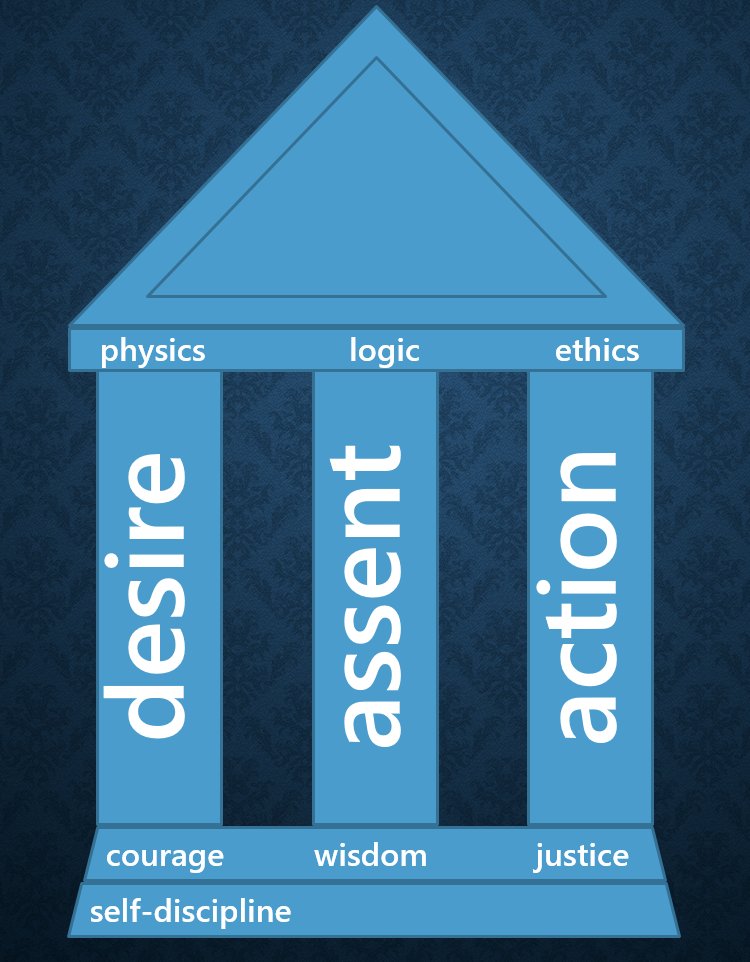
As we move into the remaining books, I will note which of the Three Disciplines Marcus is alluding to, in each passage.  What are the Three Disciplines?

They are:
1. Discipline of Desire (amor fati or love your fate)
2. Discipline of Action (treating others w/ respect, we are social beings)
3. Discipline of Assent (we are in control of our attitude)

And when I note one of the disciplines as related to a passage from Meditations, I will try to expand a bit more on it.

It may not make much sense at first.  Certainly when I first began reading Meditations late in 2015, I had a hard time following along and understanding it fully.  But I kept at it and with the help of other books (i.e. Pierre Hadot's The Inner Citadel), the layers were pealed back and things began to make sense.  I hope I can try to peal it back a bit for you as we read the Meditations together.

Monday, April 3, 2017

Commentary on Meditations: B1:17

From the gods: to have had good grandparents, good parents, a good sister, good teachers, good family, relatives, and friends - almost everything; and that I did not blunder into offending any of them, even though I had the sort of disposition which might indeed have resulted in some such offence, given the occasion - it was the grace of the gods that no set of circumstances likely to show me up ever arose.  Marcus was grateful for the fate he was born into.  I can only imagine that had he been born into a less prosperous fate, and had he learned and practiced Stoicism through some other way, he still would have been grateful for his unique set of circumstances.  He loved his fate.

That I was not brought up any longer than I was with my grandfather's mistress, and that I kept my innocence, leaving sexual experience to the proper time and indeed somewhat beyond it. He learned temperance and self-discipline.

That I came under a ruler and a father who was to strip me of all conceit and bring me to realize that it is possible to live in a palace without feeling the need for bodyguards or fancy uniforms, candelabra, statues, or the other trappings of suchlike pomp, but that one can reduce oneself very close to the station of a private citizen and not thereby lose any dignity or vigour in the conduct of a ruler's responsibility for the common good. This is one of the things as to why Stoicism appeals to so many. Some philosophies would have you meditate on a mountain, but Stoicism would have you meditate in a palace or a forest.  Your inner citadel is where you are, regardless of circumstance or position in life.

That I was blessed with a brother whose character could spur me to care for myself, and whose respect and affection were likewise a source of joy to me. We are meant to work with others. Whether they spur us to improve or support us with love and respect, humans were meant to for each other.

That my children were not born short of intelligence or physically deformed. He was grateful for the good health of his children.

That I did not make further progress in rhetoric, poetry, and the other pursuits in which I could well have been absorbed, if I had felt this my right path. He could have easily gone down a path that would have caused him to be self-absorbed.

That I was quick to raise my tutors to the public office which I thought they desired and did not put them off, in view of their youth, with promises for the future. He was not stingy with his power; he remembered those who helped him.

That I came to know Apollonius, Rusticus, Maximus. He was grateful for friendships and relationships that were put in his path.  What can we learn from this?  We may occasionally wonder why we have to be in the same room as so-and-so.  But have we asked the question: what can I learn from them?  We might be surprised by discovering new friends in unexpected crossroads.

That I acquired a clear and constant picture of what is meant by the life according to nature, so that, with regard to the gods, their communications from that world, their help and their inspiration, nothing now prevents me living the life of nature: my falling somewhat short, still, is due to my own fault and my failure to observe the promptings, not to say the instructions, of the gods. He learned early that humans are endowed with reason and logic and that we are to live according to this gift from god.  Dumb animals of the field know nothing but to eat, drink, defecate and procreate.  Humans possess a nature to learn, to grow, to find the best in life, to serve others.  When humans live according to nature, they serve others; they think; they question; they learn and grow. Also, if we are keen and observant in our life, we will discern guidance and help from all sorts of circumstances. This discernment is the ability to hear promptings from the universe or from god.

That my body has held out so far in a life such as mine. That I never touched Benedicta or Theodotus, and that later experience of sexual passion left me cured. Again, gratitude for good health and self-discipline.

That, though I was often angry with Rusticus, my behaviour never went to the point of regret. Once again, the theme of self-control.

That my mother, fated to die young, nevertheless lived her last years with me. Marcus showed his gratitude for his mother.

That whenever I wanted to help someone in poverty or some other need I was never told that there was no source of affordable money: and that I myself never fell into similar want of financial assistance from another. He displayed a desire to help others financially and he was grateful that he was in a position to help others in that regard.

That my wife is as she is, so submissive, loving, and unaffected: and that I found no lack of suitable tutors for my children. That I was given help through dreams, especially how to avoid spitting blood and bouts of dizziness: and the response of the oracle at Caieta, 'Just as you use yourself.' Again, more gratitude on his part.

That, for all my love of philosophy, I did not fall in with any sophist, or devote my time to the analysis of literature or logic, or busy myself with cosmic speculation. All these things need 'the help of gods and Fortune's favour'. In this final part of chapter 17, Marcus notes that these small choices he made earlier in life led him to a course for which he is currently grateful.  Hindsight showed him the wisdom of his earlier choices.

Wednesday, March 29, 2017

Commentary on Meditations: B1.16 - Marcus' Adoptive Father (Antoninus Pius)

From my [adoptive] father: gentleness, and an immovable adherence to decisions made after full consideration. In other words, be good natured (gentle) and kind.  Think fully and well. Then make your choice.
no vain taste for so-called honours. He was humble and did not 'get a big head' regarding his authority.

stamina and perseverance. He had the ability to stick to something. A more modern and oft-used term is "grit.” One demonstrates grit by not backing down and staying with something to the end.

a ready ear for anyone with any proposal for the common good; to reward impartially, giving everyone their due; experience of where to tighten, where to relax.  As emperor, I’m sure Marcus had lots of people approach him with proposals.  He did his best to execute justice for all; giving people a chance and by giving them a fair shake.
putting a stop to homosexual love of young men. There is not much to say here other than to note Marcus worked on self-discipline.

a common courtesy, excusing his court from constant attendance at dinner with him and the obligation to accompany him out of town, and those kept away by some other commitment always found him no different towards them. Marcus’s adoptive father was not a prima-donna.  He did not demand constant attention.  He was not haughty.

focused and persistent in deliberation in council, never satisfied with first impressions and leaving a question prematurely. I find this counsel good in today's attention-deficit-disorder world, where we can't keep our attention focused on something for more than five minutes.  Marcus learned from his adoptive father to be focused on a task at hand until it was completed.  He was not content with just hearing the talking points; rather he delved into topics and did not leave a question too early.

the concern to keep his friends, with no extremes of surfeit or favouritism. Marcus learned from him to be just with his friends and acquaintances.

his own master in all things, and serene with it. This is another observation related to self-discipline and being content.

foresight for the longer issues and unfussy control of the least detail. This part really rings true for the line of work I’m in.  We call it “having a general interest mindset.” Some people we deal with want to "haggle" about smaller amounts and they lose sight of the bigger picture.  For example, on a $1 million project, there is no point in chasing down ten-dollar issues. Or, in another example, rather than taking a hard stance on a feature which will only benefit a subset of customers for little to no value, one can agree to align with other stakeholders in order to keep the general interest united.

the check he put in his reign on acclamations and all forms of flattery. He did not let power get to his head and did not succumb to flattery.

his constant watch on the needs of the empire, his stewardship of its resources, and his tolerance of some people's criticism in this area.  He did his duty and was a good steward.  He allowed people to give him feedback and probably accepted some of it.

no superstitious fear of the gods, nor with men any populism or obsequious courting of the mob, but a sober steadfastness in all things, and nowhere any vulgar or newfangled taste. He acted according to nature; and man's nature is to act with reason.  Therefore, he did not give into superstitions nor was he swayed by the popular sentiment of the day; a sentiment which embraces the “here today, gone tomorrow” attitude.  He focused on timeless values and on reason and logic that was permanent.

In those things which conduce to the comfort of life - and here fortune gave him plenty - to enjoy them without pride or apology either, so no routine acceptance of their presence or regret in their absence. He knew his position, and did not apologize for it, or feel guilty about it, nor did he flaunt it before others.  He accepted his fate.

the fact that no one would ever describe him as a fraud or an impostor or a pedant, but rather as a man of mellow wisdom and mature experience, beyond flattery, able to take charge of his own and others' affairs. He was genuine and not two-faced.  Again, he did not let his power and position get to his head.  He simply did his duty.

Further, his high regard for genuine philosophers - for the other sort he had no hard words, but easily saw through them. To me, this speaks of the ability to see through charlatans who are people who falsely claim to have a special knowledge or skill, but in fact they are frauds. A true philosopher is someone who genuinely is searching for rock-solid truth.

sociability, too, and a sense of humour, not taken to excess; sensible care of his own body, neither vain nor valetudinarian, but not neglectful either, so that his own attention to himself left very little need for doctors, doses, or applications. Like his adoptive father we should remember that we are social beings and have a need and a duty to interact with others regularly.  Our social-ability improves when we have a smart sense of humor (not too dry and not in excess, but just right). We should also demonstrate sensible care of our body. Some may spend hours in the gym; or hours prepping and eating the best foods, while some spend no time in the gym and eat only twinkies. Both approaches to care for the body are not within reason. A valetudinarian is a person who is unduly anxious about their health. In sum, we should strike the right balance in taking care of our body.

Most importantly, his readiness to defer ungrudgingly to those with some special ability - it might be in literary expression, or the study of laws or customs or any other subject and to give them his own active support to reach acknowledged eminence in their own specialities. Some people want to be the know-it-all and will be such a know-it-all, they begin to misrepresent the truth.  The concept here is that we can and ought to defer to experts.  With that said, it would be wise to collect 360-degree feedback, to ensure as much relevant data and information has been collected.  The point here is to not be an expert in all things, but to also leverage others' knowledge.

Acting always in accordance with tradition yet not making the preservation of tradition an overt aim. When I lived in Guatemala, I often would visit homes where a sticker on the door said, "we were born catholic, we are catholic, we will die catholic."  There is no sense in preserving something that does not need to be preserved for its own sake.  If I were to amend that sentiment, I would say, "I was born to find truth, I seek the truth, I will die yearning for the truth."  We should ever be seeking and amending our outlook and philosophy on life in accordance with reason and we should not hold on to anything just for the sake of tradition.

further, no liking for change and chance, but a settled habit in the same places and the same practices. As the March 28th Daily Stoic entry says, "chaos ensues from not having a plan."  Stoics accept and even love their fate, but that does not mean they leave life to chance.  In every aspect, if they have the ability to have an influence on something and wish to make the world a better place, they should do so.  Excellence comes with habits, so build good ones.

to resume instantly after attacks of migraine, fresh again and vigorous for his usual work. Truly an impressive ability; to be able to suffer from illness or setbacks, but when addressed and rectified, having the ability to start anew.  Many suffer from loss of momentum when setbacks occur.

not to keep many matters secret to himself, only a very few exceptional cases and those solely of state concern.  Transparency is important.  Too often our society has learned hard lessons when people keep things in the dark.  Granted, there are times when discretion is needed, but the greater the transparency while managing risk, the better society is.

sense and moderation in such things as the provision of shows, contracting of public works, doles and distributions - the acts of a man with an eye for precisely what needs to be done, not the glory of its doing. To do things for the right reason instead of for greater fame or recognition is the better path.

He was not one to bathe at all hours; he had no urge to build houses; he was not particular about food, the material and colour of his clothes, or youthful beauty in his slaves; the fact that his dress came from Lorium, sent up from his country house there; the many details of his way of life at Lanuvium; how he handled the apologetic customs officer in Tusculum, and all such modes of behaviour.  Related to the care of the body, he did not take these matters to excess.  He did what was prudent.  He may have been a minimalist.

Nothing about him was harsh, relentless, or impetuous, and you would never say of him that he 'broke out a sweat': but everything was allotted its own time and thought, as by a man of leisure - his way was unhurried, organized, vigorous, consistent in all. In brief he was deliberate and ordered, in all aspects of his life.

What is recorded of Socrates would apply to him too: that he could regulate abstinence and enjoyment where many people are too weak-willed to abstain or enjoy too indulgently. It is a sad state of affairs that some people seem to ruin the fun for everyone else.  One of the key concepts I learned from my humanities and history if civilization courses in college was “moderation in all things.” If more people were moderate in their consumption, we would not have the ills that society possesses today.  There would be no drunk driving or binge drinking or pollution in the ocean.

Strength of character - and endurance or sobriety as the case may be - signifies the man of full and indomitable spirit, as was shown by Maximus in his illness. Endure life and all its trials well. Your attitude and strength of your character is everything.  Never give up. Be persistent.  Be sober.

Tuesday, March 28, 2017

Commentary on Meditations: B1.15

15. From Maximus: self-mastery, immune to any passing whim; good cheer in all circumstances, including illness; a nice balance of character, both gentle and dignified; an uncomplaining
energy for what needs to be done; the trust he inspired in everyone that he meant what he said and was well-intentioned in all that he did; proof against surprise or panic; in nothing either hurried or hesitant, never short of resource, never downcast or cringing, or on the other hand angry or suspicious; generosity in good works, and a forgiving and truthful nature; the impression he gave of undeviating rectitude as a path chosen rather than enforced; the fact that no one would ever have thought himself belittled by him, or presumed to consider himself superior to him; and a pleasant humour.

Self-mastery, also known as temperance, can be one of the most important and difficult virtues to instill within oneself. Marcus is grateful to Maximus for having learned that virtue.  In all forms, self-mastery is the gateway to finding contentment.  Whether you learn self-discipline in eating, exercise or even how you spend your leisure time, you should find ways to be in control of your desires; and master your ability to manage yourself in completing your duties.

I’m always impressed with people who demonstrate equanimity and good cheer. Your attitude is something which is ‘up to you.’ You can choose your attitude and perception of any situation. While an attitude of good cheer may not change all your circumstances, it can help you stay positive and solve your challenges more easily!

Related to your attitude is forming your character so that it is both gentle and dignified. As I think about this part of the passage, I envision a person who is not too stern, yet not too familiar. There is a right balance between in demonstrating good tact when working with people. Sometimes someone could be too formal or too stern, but equally, poor tact could be acting too informally. Furthermore, someone who strikes the right balance of demonstrating good cheer, gentleness and dignity is someone who possesses energy to always fulfill duties and solve problems without complaint.

Next, we note how Maximus was a man of his word.  We too can be someone who does what he says he will do. If you commit to something, do all that you can to keep that commitment.  Be genuine in your words; do not inflate and downplay your perception.  Speak of things as they are.  Always ensure your intentions are the best, no matter what.

Maximus was surprise-proofed and even panic-proofed! Just as something can be water-proofed so that the object is not easily damaged by water, so too can we be surprise-proofed and panic-proofed.  We should train our mind and attitude to not be surprised or panicked by anything.  Nothing should surprise or shock you, especially if you are 40 years old or older, for, after that age, you will have generally 'seen it all'.  One way to proof yourself to surprise and panic is to practice preparing for your death as well as preparing for the worst of circumstances. This practice is called premeditatio malorum.

As you prepare for difficult events and circumstances, be reserved and steady in your reactions so as to be able to apply reason and logic to any circumstance.  Do not be hurried or hesitant, rather be deliberate in your thoughts and actions.  Furthermore, be resourceful and always upbeat in your attitude. Don't be downcast or wring your hands or be angry or doubtful of everyone's motivations.

As to generosity in good works, we are reminded that there cannot be too much of a truly good thing. It would be absurd to think that someone produces too many good works. Therefore, that advice of being generous with good works, rests on a sound assumption. Along with this advice, we are to forgive quickly and frankly and not hold any grudges. In brief, forgive and forget, then move on, and simply be honest in all you do.

Maximus demonstrated an undeviating rectitude as he was a moral person and chose the right path without ever needing to be forced into that path. So too should we choose what is morally good rather than being forced into it.

Lastly, Maximus lived and acted in a way which never gave the impression that he was belittling others, nor did he give the impression that he was superior to them. He simply had a good nature about him.


Monday, March 27, 2017

Commentary on Meditations: B1.14

14. From Severus: love of family, love of truth, love of justice; to have come by his help to understand Thrasea, Helvidius, Cato, Dio, Brutus; to have conceived the idea of a balanced constitution, a commonwealth based on equality and freedom of speech, and of a monarchy which values above all the liberty of the subject; from him, too, a constant and vigorous respect for philosophy; beneficence, unstinting generosity, optimism; his confidence in the affection of his friends, his frankness with those who met with his censure, and open likes and dislikes, so that his friends did not need to guess at his wishes.

Love of family is one of the center pieces of discipline of action.  One of our closest circles of concern is with our family.  We should love and serve them foremost.

Regarding love of truth and justice, the only good is moral good and squared with that, is the love of truth and justice.  Determining the truth is not easy. It takes time and effort to arrive at it.  Love of justice is nothing other the love of others.  The less we are centered on ourselves and more on others, the closer we move to justice.

Next, Marcus admires Severus’s idea of a balanced constitution based on the principals of equality and freedom of speech which are pillars in the modern-day Republic of the United States.  One of the first times I read this passage from Meditations, I was also reading a book about Cato, entitled “Rome's Last Citizen.” Cato fought for the same ideals which Marcus appreciates and admires in this passage.

The next part of the passage discusses Severus’s vigorous respect for philosophy. I often wonder how many people simply float through life and are aimless.  If one does not think about and determine their philosophy, they will most likely allow others to guide and persuade them.  I always try to encourage those near to me in life to study and think about philosophy and then conclude what their philosophy should be. I would love to see required philosophy courses in high school, placed on the same level as math, reading and science.

Severus was generous and optimistic. We too can learn to do good and to serve others.  Be generous with your time and money.  Seek ways to improve your community, your nation, and the world. Also, being optimistic about events and the future doesn't cost a thing. You can have an optimistic attitude and live life in good faith.

Lastly, it seems that Severus was quite transparent. He didn’t seem to hide his affection for his friends, and it made it quite clear to others what his opinion of them was. It seems most people knew where he stood with his opinions of others.


Friday, March 24, 2017

Commentary on Meditations: B1.13

13. From Catulus: not to spurn a friend's criticism, even if it may be an unreasonable complaint, but to try to restore his usual feelings; to speak of one's teachers with wholehearted gratitude, as is recorded of Domitius and Athenodotus; and a genuine love for children.

The first part regarding the quality of not spurning a friend’s criticism seems to be about how friendship is greater than a friend's criticism.  The way I read this, is we ought to look past the shortcomings and "bad behavior" of our friends.  This is not to say we should associate with bad people and ignore all the bad they do, rather we should associate with good (virtuous) people and on occasion, they may not be perfect, and we ought to overlook it. In the example Marcus refers to, even if a friend’s complaint is unreasonable, we should give them the benefit of the doubt.

Regarding gratitude for our teachers, we should view many people as our teachers. Our parents, educational teachers, mentors, supervisors, managers, all do so much to help us.  We should respect them and be grateful for them.

Lastly, Marcus appreciates Catulus’s example of having genuine love for children. We would do well to remember they are humans who are still learning.

Thursday, March 23, 2017

Commentary on Meditations: B1.12

12. From Alexander the Platonist: rarely, and never without essential cause, to say or write to anyone that 'I am too busy'; nor to use a similar excuse, advancing 'pressure of circumstances', in constant avoidance of the proprieties inherent in our relations to our fellows and contemporaries.

It seems that Marcus learned to avoid the excuse of “I am too busy” when it comes to spending time with people in our important relationships.

My wife and I used to have a running joke about making each other feel a little guilty every time we had to decide between carrying out a duty and spending time with family.  Whenever one of those conflicts would come out, we'd sing "and the cat's in the cradle and the silver spoon ..."  if you don't understand that reference, then you can search on-line for the song entitle “Cats’ in the Cradle” by Harry Chapin. The gist of the song is that the dad is too busy to spend time with his kid and then eventually, when the kid is all grown up, the dad wants to spend time with the kid and the kid is too busy for the dad. It's a sad song and it's meant to give us all a major guilt trip. Without too much sappiness and guilt, the message is clear: make time with those closest to you; invest in your most important relationships; and don't let busy-ness be an excuse.

Wednesday, March 22, 2017

Commentary on Meditations: B1.11

11. From Fronto: to understand the effect of suspicion, caprice, and hypocrisy in the exercise of absolute rule; and that for the most part these people we call 'Patricians' are somewhat short of human affection.

For this passage, let me provide definitions and then some brief commentary.
Suspicion means having cautious distrust.

Caprice means a sudden and unaccountable change of mood or behavior.

Hypocrisy means the practice of claiming to have moral standards or beliefs to which one's own behavior does not conform.

A patrician is an aristocrat or nobleman.
I think another way to view this passage is to think of a time when someone treated you with suspicion.  They didn't trust you and perhaps there was no reason for them to mistrust you.

Or, think of the time when a friend or a teacher or coach went from being happy to super grumpy in a moment.

Or, think of a time when someone tells you to do one thing, but they in turn they violate their own instruction.

In each of these cases, you probably don't feel much friendship or trust toward the other person. Having identified how these things are not virtuous, then you should commit to not be that way! As Marcus says at the end, these people are "short of human affection."

Tuesday, March 21, 2017

Commentary on Meditations: B1.10

10. From Alexander the grammarian: not to leap on mistakes, or captiously interrupt when anyone makes an error of vocabulary, syntax, or pronunciation, but neatly to introduce the correct form of that particular expression by way of answer, confirmation, or discussion of the matter itself rather than its phrasing - or by some other such felicitous prompting.

In this passage, the main quality which Marcus admires is the quality of giving good feedback and coaching well. Giving feedback in order for it to be effective means providing it with tact. Tact entails being sensitive in dealing with others or with difficult issues. If someone makes a mistake, then don't be that "know-it-all" and immediately jump all over the person. Rather, start with what they did well and then offer ways for them to improve.

Think of Hermione and how she somewhat arrogantly corrects Ron: https://www.youtube.com/watch?v=fx2zLgdkJpk


Monday, March 20, 2017

Commentary on Meditations: B1.9

9. From Sextus: a kindly disposition, and the pattern of a household governed by the paterfamilias; the concept of life lived according to nature; an unaffected dignity; intuitive concern for his friends; tolerance both of ordinary people and of the emptily opinionated; an agreeable manner with all, so that the pleasure of his conversation was greater than any flattery, and his very presence brought him the highest respect from all the company; certainty of grasp and method in the discovery and organization of the essential principles of life; never to give the impression of anger or any other passion, but to combine complete freedom from passion with the greatest human affection; to praise without fanfare, and to wear great learning lightly.

A kind disposition might mean that a person's inherent qualities of mind and character focus and place emphasis on virtue and excellence of character (arete).
It would seem Sextus had a well-organized family life and was a great leader in his own home. I imagine a home that is neat, tidy and peaceful and managed in a way to allow the family to grow and learn well together.

Regarding the aspect of life lived according to nature, this will be a recurring theme in the Meditations. Indeed, all animals take care of the physical necessities, but rational animals focus on much more.  Humans write and think philosophically, and we ponder our existence.  This is our nature. We live in a higher state and as such, we should spend our efforts on living the best life according to our unique nature.

When Marcus speaks of Sextus’s unaffected dignity, I would define this as the state or quality of being worthy of honor or respect. To live with unaffected dignity perhaps means not being pretentious, or attempting to impress by affecting greater importance, talent, culture, than what one actually possesses.
Having an intuitive concern for friends might mean caring for others or having a concern for justice and not treating friends unkindly.

To tolerate both ordinary people as well as people who have empty opinions means not be so affected or annoyed by what others are doing.  Perhaps ordinary people might talk a lot about what is playing on TV or the latest viral video or just common things in life. Someone who is emptily opinioned might be someone who is dogmatic or holds an opinion without much evidence to back it up. Regardless, the key concept which Marcus admires is to not let others control your attitude.  Having the strength to tolerate ordinary people and those with empty opinions gives you improved discipline in assent.

Related to this discipline is also having an agreeable manner with all. You can be mindful of how you comport yourself and find a way to comfortably converse with most people. In brief, learn to possess civility.

Next, Marcus admires Sextus’s certainty of grasp, along with a solid method for discovering and organizing the key principles for life. This quality speaks of being cognizant of how life works, of having curiosity to learn and comprehend.  Much in today's world is given to us easily and quickly, simply because technology and access to data is always in our hands. However, we must work to truly discover something on our own.  Therefore, be curious!  Stay with an idea long enough to understand and grasp it.

Sextus never gave the impression of being angry or passionate. Rather, it seemed he lived steadily and demonstrated the ability to live with equanimity. A simple viewing of the nightly news will show how often people are swayed by anger and passions and then do something rash. Find ways to be temperate in your emotions, or better yet, to possess freedom from passion and still have human affection for others.

Lastly, Sextus could praise others without fanfare. Perhaps he learned that some people were over the top when it came to praise. Maybe because of too much fanfare in the praise, it was received as inauthentic. Similarly, to wear great learning lightly would mean to not brag.

Friday, March 17, 2017

Commentary on Meditations: B1.8

8. From Apollonius: moral freedom, the certainty to ignore the dice of fortune, and have no other perspective, even for a moment, than that of reason alone; to be always the same man, unchanged in sudden pain, in the loss of a child, in lingering sickness; to see clearly in his living example that a man can combine intensity and relaxation; not to be impatient in explanation; the observance of a man who clearly regarded as the least of his gifts his experience and skill in communicating his philosophical insights; the lesson of how to take apparent favours from one's friends, neither compromised by them nor insensitive in their rejection.

When you achieve moral freedom through your reason alone, you will have found a marvelous gift. You do not have to let your fears and worries dwell on chance.  You can use your god-given faculty, volition and reason to free your mind.

Related to moral freedom is equanimity. I yearn to be the same in temperament all the time.  People of passion, who are swayed by the slightest moral breeze are fascinating to observe but can be tiresome and unpredictable.  How unreliable these people can be. They are like dealing with a car that constantly breaks.

Marcus observed in Apollonius the ability to have both intensity and relaxation. He was both focused and intense, yet at ease in virtually any situation. When I read this description, I think of the Spock, from Star Trek. He always seemed to be focused yet relaxed in his demeanor.

Have you ever had to deal with someone who took several minutes to explain something? We are often distracted when something is not summarized or boiled down into a few words. We seem to have lost patience in modern times, and we cannot focus anymore. The ability to focus seems to be a quality that is beginning to be lost.  Can you sit and stay focused for hours at a time?  What about a single hour?  If not, then work on becoming better!

Another way to learn and apply philosophy in your life is to communicate and to teach it well. If you can take a difficult concept and teach it to someone, then you demonstrate the ability to truly learn.
When you receive favors, learn to neither be overly swayed nor to be a jerk in receiving them. Accept them with simplicity and grace.

Thursday, March 16, 2017

Commentary on Meditations: B1.7

7. From Rusticus: to grasp the idea of wanting correction and treatment for my character; not to be diverted into a taste for rhetoric, so not writing up my own speculations, delivering my own little moral sermons, or presenting a glorified picture of the ascetic or the philanthropist; to keep clear of speechifying, versifying, and pretentious language; not to walk around at home in ceremonial dress, or do anything else like that; to write letters in an unaffected style, like his own letter written to my mother from Sinuessa; to be readily recalled to conciliation with those who have taken or given offence, just as soon as they themselves are willing to turn back; to read carefully, not satisfied with my own superficial thoughts or quick to accept the facile views of others; to have encountered the Discourses of Epictetus, to which he introduced me with his own copy.

To want correction and treatment for my character means that Marcus learned to appreciate feedback as a gift.  The sooner we accept this concept; the sooner we achieve improvement and progression. Some may not like getting feedback simply because of the way it was delivered. But if regardless of how it is delivered, a person can always learn to appreciate advice in order to improve.

To not to be diverted by a taste for rhetoric might be modernized into a plain-speaking translation of (quote) don't be a pompous ass (close quote).  The urban dictionary does a fine job defining what a pompous ass is: a person who seems full of themselves and who grabs every opportunity to let others know of their feelings of superiority. More importantly, the aim of philosophy is to live it, not write about it. Indeed, writing can help ingrain ideas in your mind, but this is a means to an end.  The end is to live a good life.

When you do write letters, do so in an unaffected style. You should write and speak plainly, succinctly and to the point.

Next, Marcus learns to be readily recalled to conciliation. This is similar to the teaching of Jesus found in Matthew 5:25, where he teaches settle matters quickly and fix relationships before, they become too damaged. We should maintain good and healthy relationships with all people.  If something is broken, we should fix it quickly.

When it comes to reading, we should read carefully. We should avoid jumping to conclusions and use sound reason and logic.  My senior high school English teacher, Mr. Puckett, loved to say, "don't assume, because it will make an ass out of you and me.”

Marcus read and studied Epictetus and so should you!

Wednesday, March 15, 2017

Commentary on Meditations: B1.6

6. From Diognetus: to avoid empty enthusiasms; to disbelieve all that is talked by miracle-mongers and quacks about incantations, exorcism of demons, and the like; not to hold quail-fights or be excited by such sports; to tolerate plain speaking; to have an affinity for philosophy, and to attend the lectures first of Baccheius, then of Tandasis and Marcianus; to write essays from a young age; to love the camp-bed, the hide blanket, and all else involved in the Greek training.

When he writes of the idea of empty enthusiasm, I take this to mean "all talk, no walk.” If you are genuinely going to do something, then do it.  Do not talk about it.  Don't talk of being enthusiastic about something. Rather, you should simply demonstrate it! (see this tweet)

A healthy amount of skepticism is needed in everyone’s life. There are many who want to convince you of their power. They will try to convince you of "miracles" and "exorcisms" and "incantations."  Don’t be hasty in falling for all that you see with your eyes. Our perception and insight are not as great as you think. And there are plenty of con artists who want to gain your trust, so you loosen your wallet or even worse, your rationality.

When he talks of quail-fights, I suppose this could be similar to cockfighting.  This is all wasted time and money.  It does nothing to improve the person.  As for entertainment value, it's all sugar and no nutrition.

Some people will say that plain speaking is no virtue. Indeed, there are always different ways to speak tactfully, but you can still tolerate plain speaking. In modern times, I supposed this means to let people speak bluntly or even un-politically correctly.  Of course, we should speak with respect and intelligence, but we should also allow others to speak plainly.

Next, Marcus considers philosophy and essays. Philosophy is none other than finding a good way to live this life; and I can think of no better philosophy than what the stoics endorse.  Reading and writing about philosophy helps us to think about what it all means and how to live it. Reading and writing also reinforce what we’ve learned.

Lastly, he learns from Diognetus to love the camp-bed and Greek training. What this means to us, today, is to learn to be uncomfortable.  We should learn to tolerate camping, hot and cold weather, sleeping on the ground, and anything that helps us become more resilient.