Friday, June 4, 2021

Letters from a Stoic 70 - On the Proper Time to Slip the Cable

On the Proper Time to Slip the Cable

This post deals with and discusses suicide.

If you are in a good spot mentally speaking, then feel free read this post with all the candidness that philosophy has to offer.

But if you have suicidal thoughts or are considering suicide, please ask for professional help.  Below are phone numbers for immediate help, if you are based in the United States of America.

Crisis Text Line: Text HOME to 741741

National Suicide Prevention Lifeline: 1-800-273-8255

Trans Lifeline: 1-877-565-8860 (for the transgender community)

TrevorLifeline: 1-866-488-7386 (for LGBTQ youth)

Veterans Crisis Line: 1-800-273-8255, Press 1

If you are not based in the USA, please search on the internet for sources of help in your country, before reading this post.

****

I've contemplated taking my life.  In 2014, I was perhaps at the closest point to seriously taking it.  But as I considered the impact on my children and wife, I decided I needed help and therefore, I sought a therapist who helped me see a clearer path.  Things and life were not as dark as I was making them out to be in my mind.  I didn't have any problems that were worth dying to avoid.

Around that same time, perhaps in 2013 or 2014, I began to drink coffee and found it to be a wonderful antidote to contemplating suicide so often.  Later, I learned of a quote that has been attributed to Albert Camus which goes: "Should I kill myself, or have a cup of coffee?"  My new found love of coffee coupled with that quote resonated with me.  It's an absurd way to reframe life's challenges and problems to the point that if I ever went to that dark place, I could ask myself that question and almost all the time, I would prefer to simply go have a cup of coffee.  It became my internal rallying cry in the years 2015-2017.

I continued to see a therapist trained in cognitive behavioral therapy for about 4 months in 2014, after which I learned of the connection between CBT and Stoicism and the rest is history.  I hardly ever contemplate suicide these days, but I do contemplate my own death.  For the Stoics, death (suicide) was always open.  Seneca gets into it a bit here in the 70th letter from a Stoic.

Just a bit more commentary about suicide before delving into the letter.  I was listening to a Victor Davis Hanson podcast last week and he discussed this ancient concept of luxury and decadence (link to podcast, go to minute 45:01) and it got me thinking about how we, in this modern era and particularly in the west, have become decadent.  And, I think several years back, I was prone to consider that life was bad, when in actuality, it really wasn't that bad!  In a sense, I had become decadent.  Temporally speaking, our society has had it quite easy - air conditioning, cars, indoor plumbing, heated water at the turn of the tap, massive amounts of data and information in our pocket at all times and ample time to sit in leisure and comfort.  Just today, the jobs report for the United States came out, and one news story noted:

However, that drop in the jobless rate also came alongside an unexpected drop in the labor force participation rate to 61.6% from the 61.7% in May, suggesting a smaller share of Americans out of work returned to the labor force to look for or take new jobs.

This indicates that anxiety to work and provide for families and people is less urgent.  Stated differently, people don't feel the need to work, perhaps because of unemployment benefits and the greater application of Universal Basic Income (UBI).

Again - what is my point?  To show that to live and survive is not that difficult compared to many people living in 3rd world countries today as well as compared to people who lived decades and centuries ago.  For me personally, it shows my excuses and complaints were and are small and I really didn't and don't have such a great grievance to justify contemplating taking my life.  This theme will emerge a bit in Seneca's letter.

He begins the letter by comparing life with a voyage.  Some reach the destination slowly; others quickly.

if a man has reached this harbour in his early years, he has no more right to complain than a sailor who has made a quick voyage. For some sailors, as you know, are tricked and held back by sluggish winds, and grow weary and sick of the slow-moving calm; while others are carried quickly home by steady gales.  You may consider that the same thing happens to us: life has carried some men with the greatest rapidity to the harbour, the harbour they were bound to reach even if they tarried on the way, while others it has fretted and harassed.

He then gets into the quality of life, which is what wisdom seeks.  It's not so much about quantity or length.

mere living is not a good, but living well. Accordingly, the wise man will live as long as he ought, not as long as he can.  He will mark in what place, with whom, and how he is to conduct his existence, and what he is about to do. He always reflects concerning the quality, and not the quantity, of his life. As soon as there are many events in his life that give him trouble and disturb his peace of mind, he sets himself free.

If you lead a rational life, you will contemplate this idea: that a life worth living, is also worth living well.  And once you've determined it's worth living, then your task is to live it well and even to end it well.  I've heard a similar sentiment about one's career.  Several people and managers at work say that as long as their job is interesting, they show up to work.  They realize that some days are just horrible, long and disastrous.  But they know that not all days are like that.  They also think about where they ought to draw the line of continuing to show up at work or to resign or retire.  One manager said that as long as he has 3 good days, he can accept a couple of bad days a week.  But as soon as it becomes 3 and then 4 bad days, he'll know when to call it quits.  It seems that Seneca is saying something similar with regard to living.

Seneca even offers an example of living ill (the opposite of living well).

This person was thrown into a cage by his tyrant, and fed there like some wild animal. And when a certain man advised him to end his life by fasting, he replied: "A man may hope for anything while he has life."  This may be true; but life is not to be purchased at any price. No matter how great or how well-assured certain rewards may be I shall not strive to attain them at the price of a shameful confession of weakness.

In other words, just because you can live doesn't not mean you ought to.  Living well is the goal of a philosopher and a good human.

Socrates continued to live well (rather than take his own life) and to prove a point (teach) his friends and the Athenians.

Socrates might have ended his life by fasting; he might have died by starvation rather than by poison. But instead of this he spent thirty days in prison awaiting death, not with the idea "everything may happen," or "so long an interval has room for many a hope" but in order that he might show himself submissive to the laws and make the last moments of Socrates an edification to his friends.

In living and in choosing death, we should do both rationally.

Do not be mindless about living or dying.  But have a purpose.  Seneca writes:

Every man ought to make his life acceptable to others besides himself, but his death to himself alone. The best form of death is the one we like.  Men are foolish who reflect thus: "One person will say that my conduct was not brave enough; another, that I was too headstrong; a third, that a particular kind of death would have betokened more spirit." What you should really reflect is: "I have under consideration a purpose with which the talk of men has no concern!"

A rational being will seek and know his purpose, though it is not an easy task.  A wise person, therefore, will not simply default into the thinking of: "I'll let Nature decide when I die."  Rather, the wise person will know why he lives and when he should die.  If he complains about living, then perhaps he does not know his reason for living.  But Nature has given every one of us the choice to die or keep on living.  Seneca echoes the idea often written by Marcus Aurelius.

This is the one reason why we cannot complain of life: it keeps no one against his will. Humanity is well situated, because no man is unhappy except by his own fault. Live, if you so desire; if not, you may return to the place whence you came.

If you desire to hold on to life as long as possible, then pivot your thinking that your body is similar to a home: you can't live there forever.

Live in it as if you were about to leave it. Keep thinking of the fact that some day you will be deprived of this tenure; then you will be more brave against the necessity of departing.

While fortune may not test us on other matters and therefore we must practice them on our own (poverty, hardships, etc), there is one thing we must prepare for yet can't practice: our death.  Therefore, we ought to contemplate death often.

Seneca next goes into various examples of people who were put in horrible circumstances, and were prevented from killing themselves at every turn.  Yet, they sill managed!  Seneca cites these examples to prove that the door to leave life is, indeed, open to all.  He cites gladiators who shoved a wood stick tipped with a sponge down their throats, and who broke their necks with the spokes of a cart wheel while it was moving and one who used a spear to kill himself, by shoving it down his throat.  Again, the point of which is to prove that death is open to us all and that "the foulest death is preferable to the fairest slavery."

And, if death is open to the lowest of people (gladiators), then why should it not be available to rational people as well.

If such a spirit is possessed by abandoned and dangerous men, shall it not be possessed also by those who have trained themselves to meet such contingencies by long meditation, and by reason, the mistress of all things? It is reason which teaches us that fate has various ways of approach, but the same end, and that it makes no difference at what point the inevitable event begins.  Reason, too, advises us to die, if we may, according to our taste; if this cannot be, she advises us to die according to our ability, and to seize upon whatever means shall offer itself for doing violence to ourselves.

 In sum, the takeaways are:

- seek help if you are suicidal

- stay alive to find your purpose

- live with a purpose

- live rationally

- contemplate death - it is all our fates

- as far as you can, rationally choose your death

Sunday, May 30, 2021

Letters from a Stoic 69 - On Rest and Restlessness

On Rest and Restlessness

The previous letter discussed retirement from work.  It would seem this letter is somewhat of a continuation, as Seneca advises Lucilius to cease his meandering and itchy legs.

the spirit cannot through retirement grow into unity unless it has ceased from its inquisitiveness and its wanderings.

As one enters a retirement phase of life and takes on more hours to the study of philosophy, he must focus and attempt to unify his soul and actions.  Too long, one has given into the things of indifferents and now one must direct his full attention to the pursuit of wisdom.

Give your eyes time to unlearn what they have seen, and your ears to grow accustomed to more wholesome words. ...  he who would lay aside his desire for all the things which he used to crave so passionately, must turn away both eyes and ears from the objects which he has abandoned.

Therefore, while in retirement and in a focused pursuit of love of wisdom, one must turn away from what he lusted after most of his life.  A whole life-time is not enough to rid oneself of all vices, let alone a few decades of retirement.  Therefore, in retirement, all the more sense of urgency ought to be applied.

Vices tempt you by the rewards which they offer; but in the life of which I speak, you must live without being paid. Scarcely will a whole life-time suffice to bring our vices into subjection ... Even constant care and attention can scarcely bring any one undertaking to full completion.

I don't know what my own retirement from the workforce will be like.  I've often contemplated that it ought to be lived in quiet and in minimalist fashion, rather than buying a large home and expensive cars.  When I contemplate what retirement might look like for my wife and I, I tend to think it will be found in a small, but comfortable home; we will drive cars that get us there and we will spend our time with kids and grandkids.  And the rest of my time, I hope, will be spent reading, writing and teaching philosophy to others, while continuing my own pursuit of wise and just and temperate living.

Monday, May 24, 2021

Letters from a Stoic 68 - On Wisdom and Retirement

On Wisdom and Retirement

The three big points I gleaned from this letter are:

1. a Stoic (cosmopolitan) never retires from the universe

2. hide your retirement (from the daily grind) in plain sight

3. in the pursuit of wisdom, it's better late than never

The Cosmopolitan's Work Never Stops

While a Stoic may decide to retire from employment, he ought to have learned he never retires from the Cosmos.  He still yet has work to accomplish.

when we have assigned to our wise man that field of public life which is worthy of him, – in other words, the universe, – he is then not apart from public life, even if he withdraws; nay, perhaps he has abandoned only one little corner thereof and has passed over into greater and wider regions; and when he has been set in the heavens, he understands how lowly was the place in which he sat when he mounted the curule chair or the judgment-seat. Lay this to heart, – that the wise man is never more active in affairs than when things divine as well as things human have come within his ken.

In his retirement from employment, he has work on his soul yet to accomplish.  He may spend time reflecting on wisdom and perhaps he may observe that he can share this wisdom with those who still have years of life left on this rock floating in the Cosmos.  When the retired Stoic begins to see the divine as well as daily human affairs, perhaps he can share counsel for his fellow-travelers who will cross the path he treads today.

Retirement from Employment Ought to be Hidden in Plain Sight

Making a show of your retirement from employment may attract attention.  The flash of expensive cars and big homes may indicate the wealth you have amassed over a lifetime of work, but to satisfy the ego may welcome prying eyes and thieves.  Therefore, Seneca advocates us to not "vaunt one's retirement" but that we also ought not to "[withdraw] from the sight of men" as this also is a form of vaunting.  To vaunt also means to advertise and "to advertise one's retirement is to collect a crowd."

Therefore, retire from your employment, but do it in plain sight.  Perhaps, find a home that suits your needs rather than your ego.  Drive a car that gets you to where you need to go, but no need to be flamboyant.  I can't help but think of Sam Walton driving the same truck from 1979 to 1992, even after earning millions of dollars.

Retirement from Employment, but not from Work

And even after you retire from employment, you still have work to do.

When you withdraw from the world your business is to talk with yourself, not to have men talk about you. But what shall you talk about? Do just what people are fond of doing when they talk about their neighbours, – speak ill of yourself when by yourself; then you will become accustomed both to speak and to hear the truth. Above all, however, ponder that which you come to feel is your greatest weakness.

When the lionshare of our day is no longer spent in work meetings, then we will have time to hone in on our weakness, in order to correct them.  If others were to spot our weaknesses, what would they say?  This is how we ought to approach finding our weaknesses when we have much more time on our hands.

What, then, am I myself doing with my leisure? I am trying to cure my own sores ...  I do recommend retirement to you, but only that you may use it for greater and more beautiful activities than those which you have resigned.

But what is the point of self-improvement at such a late stage of life?

Let us do what men are wont to do when they are late in setting forth, and wish to make up for lost time by increasing their speed – let us ply the spur ... I shall depart a better man.

If you are convinced there is a path to wisdom, then get yourself going on the path.  Never deviate from the path once you are convinced.  And if you've not achieved the attainment of wisdom before you retire from your active life, then use your new-found time to pursue this noble quest.  You will have departed this life "a better man."

None of us know what awaits us after death.  Perhaps we have lived and will thousands of times as part of the Eternal Recurrence or perhaps we regress or progress into another life based on Buddhist reincarnation.  Or, maybe this is the only life we will live and there is nothing before or after it.  Regardless of your perspective, I think there is a case to be made that we should never give up our quest for wisdom and improving ourselves.  Our allotted time is sufficient; we simply need enough urgency to get going and to keep pursuing.

Tuesday, May 11, 2021

Letters from a Stoic 67 - On Ill-Health and Endurance of Suffering

On Ill-Health and Endurance of Suffering

Premise: the good is desirable

Premise: to be courageous under torture is good

Therefore: we should desire torture

More or less, that is the claim Lucilius seems to be making, to which Seneca replies:

there is something in them that is to be desired. I should prefer to be free from torture; but if the time comes when it must be endured, I shall desire that I may conduct myself therein with bravery, honour, and courage. Of course I prefer that war should not occur; but if war does occur, I shall desire that I may nobly endure the wounds, the starvation, and all that the exigency of war brings. Nor am I so mad as to crave illness; but if I must suffer illness, I shall desire that I may do nothing which shows lack of restraint, and nothing that is unmanly. The conclusion is, not that hardships are desirable, but that virtue is desirable, which enables us patiently to endure hardships.

The concept of "preferred indifferents" emerges strongly in this passage.  The Stoic knows that Fortune or Fate will make us prosperous or poor; it may ravage our body with sickness or grant us long-lasting health and life; it may cause war and famine to sweep over our country or it may grant us peace.  Regardless of these circumstances, we, rational beings, will choose how we react to each event - this is 'up to us' - we choose (or not) to exercise moral virtue.  But, back to the point that Lucilius raises and Seneca addresses.  Ought a Stoic to desire torture?  Seneca would respond: 'no, but she ought to desire to demonstrate excellence of soul if her fate placed torture in her path.'  In this example, 'torture' would be a "non-preferred indifferent."

Sellars quotes Cicero:

All other things, he [Zeno] said, were neither good nor bad, but nevertheless some of them were in accordance with Nature and others contrary to Nature; also among these he counted another interposed or intermediate class of things. He taught that things in accordance with Nature were to be chosen and estimated as having a certain value, and their opposites the opposite, while things that were neither he left in the intermediate class. Th ese he declared to possess no motive force whatever, but among things to be chosen some were to be deemed of more value and others of less: the more valuable he termed “preferred”, the less valuable, “rejected” [i.e. “non-preferred”]. (Acad. 1.36–7) (see Sellars, Stoicism, p. 111).

While a Stoic may voluntarily endure hardships to toughen herself, she does not seek them out per se.  She would prefer life over death; health over illness; peace over war.  But regardless of what Fate sends her way, she will act with virtue in every case.

Many in the ancient world clearly knew that all of us will reap the same, ultimate fate: death.  Therefore, what many sought and preferred, was to die for a cause (as opposed for no cause, or needlessly).  A stark example today would be: would you prefer to die of a heart attack while eating ice cream and cake or would you prefer to die by throwing yourself on a grenade to save your platoon?  One death demonstrates a preference for vice while another demonstrates courage and love of brother.

Do you doubt, then, whether it is best to die glorious and performing some deed of valour? When one endures torture bravely, one is using all the virtues. Endurance may perhaps be the only virtue that is on view and most manifest; but bravery is there too, and endurance and resignation and long-suffering are its branches.

In many cases, Fate throws surprises at us and in a single reaction, we demonstrate an amazing act of virtue - such as taking a bullet for a brother.  Other acts of Fate are slow and the Stoic who demonstrates a deep understanding of cause and effect, knows what awaits him and still makes the rational choice to demonstrate excellence.

There, too, is foresight; for without foresight no plan can be undertaken; it is foresight that advises one to bear as bravely as possible the things one cannot avoid.

Seneca's words from ancient Rome echo still today.  What we witness on social media, in public and on television is an unending stream of examples of people seeking pleasure at all costs and avoiding virtue.  A wise person will pause and reflect on the perspectives of aimless people as well as how a excellent human being appears.

withdraw for a little space from the opinions of the common man. Form a proper conception of the image of virtue, a thing of exceeding beauty and grandeur; this image is not to be worshipped by us with incense or garlands, but with sweat and blood.

Seneca concludes with a couple of examples and admonishes us to amor fati.

I think of our friend Demetrius, who calls an easy existence, untroubled by the attacks of Fortune, a "Dead Sea."  If you have nothing to stir you up and rouse you to action, nothing which will test your resolution by its threats and hostilities; if you recline in unshaken comfort, it is not tranquillity; it is merely a flat calm.

The Stoic Attalus was wont to say: "I should prefer that Fortune keep me in her camp rather than in the lap of luxury. If I am tortured, but bear it bravely, all is well; if I die, but die bravely, it is also well."

Tuesday, May 4, 2021

Letters from a Stoic 66 - On Various Aspects of Virtue

On Various Aspects of Virtue

The Stoic motto "live according to Nature" has multiple levels of meaning.  This letter discusses one of those levels

He speaks of a friend, who's body is feeble and weak, but who's spirit and character is great.  He contemplates how Nature (i.e. the Universe / Cosmos / God) proves to us (humanity) that it is the soul - the character - that matters more than the body.

For Nature acted unfairly when she gave him a poor domicile for so rare a soul; or perhaps it was because she wished to prove to us that an absolutely strong and happy mind can lie hidden under any exterior. ... A great man can spring from a hovel; so can a beautiful and great soul from an ugly and insignificant body. For this reason Nature seems to me to breed certain men of this stamp with the idea of proving that virtue springs into birth in any place whatever. ... Nature does a still greater thing, for she produces certain men who, though hampered in their bodies, none the less break through the obstruction.

This last part, when he speaks of certain men who "break through the obstruction" reminds me of Marcus Aurelius speaking of the obstacle being way.  To be clear, the body is a Stoic indifferent.  It is not the Good, as it is a thing that does not depend on the truly unique part of us.  In the example of Seneca's friend, his body is the obstacle and the way for him to demonstrate excellence of soul or character is to prove that one can demonstrate courage, justice, diligence and wisdom regardless of the condition of your body.  I think of Stephen Hawking as a modern example.

The next section is about his conversation with his friend.

how can goods be equal if they are of three kinds?  For certain of them, according to our philosophical tenets, are primary, such as joy, peace, and the welfare of one's country. Others are of the second order, moulded in an unhappy material, such as the endurance of suffering, and self-control during severe illness. We shall pray outright for the goods of the first class; for the second class we shall pray only if the need shall arise. There is still a third variety, as, for example, a modest gait, a calm and honest countenance, and a bearing that suits the man of wisdom.

When he talks of three kinds of goods, I think he's referring to Stoic indifferents.  The first kind would be preferred indifferents; those indifferents which conduce virtue.  The second class he refers to would be dis-preferred indifferents; or those which may make it generally more difficult to exercise virtue. The third kind are purely neutral. John Sellars explains this in his book entitled Stoicism. He wrote,

the Stoics suggest that there is nothing wrong with preferring some indifferents over others. It is perfectly natural, they suggest, to prefer to be healthy rather than ill or rich rather than poor. Health and wealth would be examples of “preferred indifferents”, with sickness and poverty being “dispreferred indifferents”. As for completely neutral indifferents with no motivating force whatsoever, an example might be whether one had an odd or even number of hairs on one’s head (p. 80 of 2nd edition, 2026).

Returning to Seneca, when he says "pray" I interpret that to mean more like 'prefer' or 'wish' as opposed to formal prayers.

A Stoic does not act indifferently to Stoic indifferents.  These Stoic indifferents are the material for demonstrating excellence of character.  In all three types of indifferents Seneca mentions, our goal is to rise above them.  Seneca elaborates:

the soul that gazes upon truth, that is skilled in what should be sought and what should be avoided, establishing standards of value not according to opinion, but according to nature, – the soul that penetrates the whole world and directs its contemplating gaze upon all its phenomena, paying strict attention to thoughts and actions, equally great and forceful, superior alike to hardships and blandishments, yielding itself to neither extreme of fortune, rising above all blessings and tribulations, absolutely beautiful, perfectly equipped with grace as well as with strength, healthy and sinewy, unruffled, undismayed, one which no violence can shatter, one which acts of chance can neither exalt nor depress, – a soul like this is virtue itself.

If I were to rephrase briefly, I would say an excellent soul is neither overcome with joy nor defeated by pain, but retains equanimity in all things and strives to see all things and events from the perspective of Nature; of God.

He continues;

For the Supreme Good cannot diminish, nor may virtue retrograde; rather is it transformed, now into one quality and now into another, shaping itself according to the part which it is to play.  Whatever it has touched it brings into likeness with itself, and dyes with its own colour. It adorns our actions, our friendships, and sometimes entire households which it has entered and set in order. Whatever it has handled it forthwith makes lovable, notable, admirable.

I may be wrong and perhaps others will inform me of how to comprehend this passage.  But it seems to me, that Seneca is saying that the "Supreme Good" is Nature; and as we humans are a part of Nature, we exercise what is truly ours - choice and attitude - to understand our part to play and then to play it well.  Nature "touches" us - it impacts us through events and circumstances - we might call it Fate.  And our part is to exercise our virtue.  We shape ourselves according to the part we ought to play.  As Nature proceeds and as we act with virtue, we are dyed with Nature's color - we live according to Nature.

And for humans to be good - to be a part of the Supreme Good - we are to be good ourselves, by exercising moral virtue.  Moral virtue is absolute and cannot be improved.

You will find nothing straighter than the straight, nothing truer than the truth, and nothing more temperate than that which is temperate.  Every virtue is limitless; for limits depend upon definite measurements. Constancy cannot advance further, any more than fidelity, or truthfulness, or loyalty. What can be added to that which is perfect? ... Honour, also, permits of no addition; for it is honourable because of the very qualities which I have mentioned.  What then? Do you think that propriety, justice, lawfulness, do not also belong to the same type, and that they are kept within fixed limits? The ability to increase is proof that a thing is still imperfect.

Seneca invokes the scala naturae again by noting the virtues of plants, which are perishable, and the virtues of humans, which are as enduring as Reason itself, since we have a portion of it within us.

to human virtues only one rule applies. For right reason is single and of but one kind. Nothing is more divine than the divine, or more heavenly than the heavenly.  Mortal things decay, fall, are worn out, grow up, are exhausted, and replenished. Hence, in their case, in view of the uncertainty of their lot, there is inequality; but of things divine the nature is one. Reason, however, is nothing else than a portion of the divine spirit set in a human body.

Seneca paints a picture of human excellence, regardless of circumstances.

the other virtues are also equal as compared with one another: tranquility, simplicity, generosity, constancy, equanimity, endurance. For underlying them all is a single virtue – that which renders the soul straight and unswerving. ... Virtue is not changed by the matter with which it deals; if the matter is hard and stubborn, it does not make the virtue worse; if pleasant and joyous, it does not make it better. Therefore, virtue necessarily remains equal. For, in each case, what is done is done with equal uprightness, with equal wisdom, and with equal honour. Hence the states of goodness involved are equal, and it is impossible for a man to transcend these states of goodness by conducting himself better, either the one man in his joy, or the other amid his suffering.

Retaining equanimity and being constant in any circumstance and event is a difficult proposition.  This is why there are no sages.  This is why previewing the day and then reviewing it at the end helps us contemplate the many different scenarios we face.  The practice of premeditatio malorum also helps us prepare to respond to the many different curve balls life throws at us.

Doing the morally correct thing must be done for the right reasons and it should be done willingly.  Just doing the right thing, but unwillingly, is not a demonstration of excellence.

no act is honourable that is done by an unwilling agent, that is compulsory. Every honourable act is voluntary. Alloy it with reluctance, complaints, cowardice, or fear, and it loses its best characteristic – self-approval. That which is not free cannot be honourable; for fear means slavery.  The honourable is wholly free from anxiety and is calm ...  when a man is about to do something honourable, he should not regard any obstacles as evils, even though he regard them as inconvenient, but he should will to do the deed, and do it willingly.

While a Stoic may prefer the indifferent of joy and dis-prefer the indifferent of pain, when it comes to demonstrating excellence of soul, the good man will do the right thing regardless if joy or pain are involved.

the good man will hasten unhesitatingly to any noble deed; even though he be confronted by the hangman, the torturer, and the stake, he will persist, regarding not what he must suffer, but what he must do; and he will entrust himself as readily to an honourable deed as he would to a good man.

The good man can demonstrate virtue whether he is rich or poor.  Whatever Fortune or Fate has given him, he will make good use of it.

virtue is just as praiseworthy if it dwells in a sound and free body, as in one which is sickly or in bondage. ... For all those things over which Chance holds sway are chattels, – money, person, position; they are weak, shifting, prone to perish, and of uncertain tenure. On the other hand, the works of virtue are free and unsubdued, neither more worthy to be sought when fortune treats them kindly, nor less worthy when any adversity weighs upon them.

The next section (24-27) is a bit obscure, but to me it seems Seneca is simply saying that virtuous (excellent) acts of moral behavior are equal, regardless of the "accessories" that surround the individual.  These "accessories" would be nothing more than indifferents.  You admire a good person because they are morally good; and you do not differentiate your love for the poor, weak good man and the wealthy, healthy good man.  Good is good.  He compares this equality to a loving parent.  A parent loves all her children.  If, however, a child faces hardships, there may be more care or help given to them.

Virtue, too, does not necessarily love more deeply those of her works which she beholds in trouble and under heavy burdens, but, like good parents, she gives them more of her fostering care.

Returning to the "good is good" concept; Seneca makes a finer point, which somewhat hits on the "preferred indifferents" aspects of Stoicism, when he says the first example of virtue is "desirable" and the second is "worthy of admiration."

there is an equality between feeling joy with self-control and suffering pain with self-control. The joy in the one case does not surpass in the other the steadfastness of soul that gulps down the groan when the victim is in the clutches of the torturer; goods of the first kind are desirable, while those of the second are worthy of admiration; and in each case they are none the less equal.

Philosophy helps us aim higher than the pursuit of indifferents.  What most people chase and admire is foolishness and brings nothing but "empty joy."  Also, we often fear that which is irrational.  Those who are educated in these two very important aspects of life can find a path to live rationally knowing not to chase one and avoid the other.  Many other people use these two facts to manipulate others; either to pursue indifferents or to instill fear into them in order to sell a solution to address that fear.  To avoid not being played by this sort of person, open your eyes to the reality of the situation and be rational.

those things which are thoughtlessly praised, and are goods in the opinion of the mob merely puff us up with empty joy. And again, those things which are feared as if they were evils merely inspire trepidation in men's minds, for the mind is disturbed by the semblance of danger, just as animals are disturbed. Hence it is without reason that both these things distract and sting the spirit; the one is not worthy of joy, nor the other of fear.

Seneca plays the preferred indifferents pretty strongly.

certain goods which reason regards as primary, to which she addresses herself purposely; these are, for example, victory, good children, and the welfare of one's country. 

I would agree with him about "good children" and "welfare of one's country", but I'm not so sure about the "victory" one.  I tend to think that preferred indifferents ought to be beneficial for all people in the world.  We all want our children to be good; good children are good for the world.  The same would be true for the welfare of the country - we want people to have food, to generally be healthy and be afforded an opportunity to live a good life.  As to "victory" this would imply someone or some other people lost.  Therefore, how could this be beneficial for all?

He makes a finer point on this topic.  While we prefer some indifferents, we still nonetheless can demonstrate excellence in the face of adversity.

being wounded, wasting away over a fire, being afflicted with bad health, – such things are contrary to nature; but it is in accordance with nature for a man to preserve an indomitable soul amid such distresses.

Later on he says that he would actually prefer the harsher hardships.

if any goods could be greater than others, I should prefer those which seem harsh to those which are mild and alluring, and should pronounce them greater. For it is more of an accomplishment to break one's way through difficulties than to keep joy within bounds.  It requires the same use of reason, I am fully aware, for a man to endure prosperity well and also to endure misfortune bravely. 

He ends by alluding to some story of Mucius, who willed his maimed hand to be held over some fire, defying his enemy.  And his enemy, fearing that the fame of Mucius would be greater, ordered that the fire be removed.  Thus Mucius became victorious over his enemy.

This was a very long, rambling letter and was somewhat difficult to follow.  It took me a few days to read it and try to understand what Seneca was trying to convey.  I hope this was useful in some way for anyone who comes across this post.

Sunday, April 25, 2021

Letters from a Stoic 65 - On the First Cause

On the First Cause

Seneca and some friends have a debate about the prime cause of the universe.  It seems his friends perhaps tilt towards the Platonic and Aristotelian perspectives.  Seneca does a fine job summarizing the differing perspectives.

For the Stoics, the prime cause is Nature/Reason/Cosmos/the Universe.  And to be even more specific, it is pneuma that is the prime mover and cause of all actions in the universe.

two things in the universe which are the source of everything, – namely, cause and matter.  Matter lies sluggish, a substance ready for any use, but sure to remain unemployed if no one sets it in motion. Cause, however, by which we mean reason, moulds matter and turns it in whatever direction it will, producing thereby various concrete results.

...

The Stoics believe in one cause only, – the maker.

Elsewhere, Aetius states,

The Stoics made god out to be intelligent, a designing fire which methodically proceeds towards creation of the world, and encompasses all the seminal principles according to which everything comes about according to fate, (2) and a breath pervading the whole world, which takes on different names owing to the alterations of the matter through which it passes (The Hellenistic Philosophers, Long, Sedley, p. 274-275).

After contrasting the Stoic view with the Platonic and Aristotelian, the question becomes very deeply philosophical.

Do you ask what God's purpose is?

Seneca states that God's purpose is goodness.

Elsewhere, I've written about what I've learned in the College of Stoic Philosophers, in which I noted others' theories that God not only has infinite potential, but God's purpose is to experience all that potential (see the God, Determinism and Free Will section of my essay on Stoic Physics).

Seneca then addresses a very practical question:

"What pleasure do you get from wasting your time on these problems, which relieve you of none of your emotions, rout none of your desires?"

His response to the question he poses, is worth reading in its entirety.

So far as I am concerned, I treat and discuss them as matters which contribute greatly toward calming the spirit, and I search myself first, and then the world about me.  And not even now am I, as you think, wasting my time. For all these questions, provided that they be not chopped up and torn apart into such unprofitable refinements, elevate and lighten the soul, which is weighted down by a heavy burden and desires to be freed and to return to the elements of which it was once a part. For this body of ours is a weight upon the soul and its penance; as the load presses down the soul is crushed and is in bondage, unless philosophy has come to its assistance and has bid it take fresh courage by contemplating the universe, and has turned it from things earthly to things divine. There it has its liberty, there it can roam abroad; meantime it escapes the custody in which it is bound, and renews its life in heaven.

Marcus Aurelius, similarly took a metaphysical flight through the cosmos, perhaps too, contemplating God's purpose.

the rational soul traverses the whole universe and its surrounding void, explores the shape of it, stretches into the infinity of time, encompasses and comprehends the periodic regeneration of the Whole (Meditations 11.1).

And lastly, I recently came across this passage by Pierre Hadot in The Present Alone is Our Happiness where he said,

Things changed at the time of my adolescence.  Indeed, I have long had the impression of having been in the world only from the time I became an adolescent.  I will always regret having thrown away - out of Christian humility - my first handwritten notes that were an echo of the birth of my personality, for it is very difficult for me now to rediscover the psychological content of the overwhelming discoveries I made then.  I do remember their context.  One happened on rue Ruinart, on the route I took home to my parents' house every day from the Petit Seminaire.  Night had fallen.  The stars were shining in an immense sky; one could still see them at the time.  Another took place in a room of our house.  In both cases I was filled with an anxiety that was both terrifying and delicious, provoked by the sentiment of the presence of the world, or of the Whole, and of me in that world.  In fact, I was incapable of formulating my experience, but after the fact I felt that it might correspond to questions such as What am I?  Why am I here?  What is this world I am in?  I experienced a sentiment of strangeness, of astonishment, and of wonder at being there.  At the same time I had the sentiment of being immersed in the world, of being a part of it, the world extending from the smallest blade of grass to the stars. This world was present to me, intensely present.  Much later I would discover that this awareness of my immersion in the world, this impression of belonging to the Whole, was what Romain Rolland called the "oceanic feeling."  I think I have been a philosopher since that time, if by philosophy one understands this awareness of existence, of being-in-the-world (p. 5-6).

In a sense, it seems that Seneca, Aurelius and Hadot speak of out-of-body experiences.  Seneca reminds us that our body is a form of slavery and that we ought to spend our experience in the higher sphere rather the bodily.

The wise man, the seeker after wisdom, is bound closely, indeed, to his body, but he is an absentee so far as his better self is concerned, and he concentrates his thoughts upon lofty things. Bound, so to speak, to his oath of allegiance, he regards the period of life as his term of service. He is so trained that he neither loves nor hates life; he endures a mortal lot, although he knows that an ampler lot is in store for him.

Seneca then rhetorically asks thirteen deep questions, to demonstrate to Lucilius, that questions - philosophical questions - can have a freeing effect on our minds and that we are not slaves to our bodies and that our minds can contemplate and discuss such lofty subjects.

this freedom will be greatly helped by the contemplation of which we were just speaking.

He then evokes the Scala naturae in the context of God and humans.

All things are made up of matter and of God; God controls matter, which encompasses him and follows him as its guide and leader. And that which creates, in other words, God, is more powerful and precious than matter, which is acted upon by God.  God's place in the universe corresponds to the soul's relation to man. World-matter corresponds to our mortal body; therefore let the lower serve the higher. Let us be brave in the face of hazards. Let us not fear wrongs, or wounds, or bonds, or poverty.

And the very essence of us is pneuma as displayed by our hegemonikon.  While we are a part of the Cosmos and the Whole, we nevertheless have autonomy in how we display that which is unique to us.  While the indifferents in our life (hazards, fears, wrongs, wounds, bonds, poverty, riches, etc.) do not represent us entirely, it is our unique response to these things which define us.  In our space of choice, is how we exercise our autonomy, creativity, personality and virtue: our arete.

Sunday, April 18, 2021

Letters from a Stoic 64 - On the Philosopher's Task

On the Philosopher's Task

The point of this letter:

we should play the part of a careful householder; we should increase what we have inherited

Seneca praises Quintus Sextius the Elder because his style of writing "fills [Seneca] with a mighty confidence before [he] closes his book" and causes him to say:

I want to challenge every hazard; I want to cry: "Why keep me waiting, Fortune? Enter the lists! Behold, I am ready for you!"

Therefore, we inheritors of philosophy ought to praise and honor our philosophical fore-fathers and then we ought to dedicate our time to solving problems and applying treatment.

I worship the discoveries of wisdom and their discoverers; to enter, as it were, into the inheritance of many predecessors is a delight. It was for me that they laid up this treasure; it was for me that they toiled. But we should play the part of a careful householder; we should increase what we have inherited.

It then becomes our task to "adding something further."

The cures for the spirit also have been discovered by the ancients; but it is our task to learn the method and the time of treatment.  Our predecessors have worked much improvement, but have not worked out the problem.

More and more, we, humanity, are learning over again, hard-fought lessons our forbearers learned.  While our challenges may not be all too different from theirs', how we approach and re-learn solutions may demand creativity.

Related to this are a few quotes from Vauvenargues, who Pierre Hadot cites in "Philosophy as a Way of Life" (see p. 108 and footnote 184 of the chapter):

"Every thought is new when the author expresses it in his own way"

"There are many things we do not know well enough, and that it is good to have repeated."

"A truly new and truly original book would be one which made people love old truths."

Thursday, April 15, 2021

Letters from a Stoic 63 - On Grief for Lost Friends

On Grief for Lost Friends

Lucilius' friend, Flaccus, died and Seneca is writes about grief.

Stoics are not without emotion.  The excess and deficiency are perhaps not ideal.  Therefore, when grief comes as a result of a loss of a friend or loved one, we should neither grieve with excess nor should we lack grief at all.

I would not have you sorrow more than is fitting. That you should not mourn at all I shall hardly dare to insist ... Let not the eyes be dry when we have lost a friend, nor let them overflow. We may weep, but we must not wail.

Some people may truly be deeply grieving, but if they do not cease at some point, then there may be deeper issues or perhaps it is for show.

It is because we seek the proofs of our bereavement in our tears, and do not give way to sorrow, but merely parade it. No man goes into mourning for his own sake. Shame on our ill-timed folly! There is an element of self-seeking even in our sorrow.

Later in the letter he write,

The reason why they lament too unrestrainedly at such times is that they are afraid lest men doubt whether they really have loved; all too late they seek for proofs of their emotions.

To grieve is human, to grieve excessively is folly.  It would seem excessive grief is no longer about the lost loved one but about the griever!

Therefore, we ought to grieve, let our grief be about the person who we lost, and let us move on contemplating the memory of the one lost.

Let us see to it that the recollection of those whom we have lost becomes a pleasant memory to us. No man reverts with pleasure to any subject which he will not be able to reflect upon without pain. So too it cannot but be that the names of those whom we have loved and lost come back to us with a sort of sting; but there is a pleasure even in this sting.

And if we contemplate the death of our friends, similarly to how we contemplate our own death, we will enjoy the company of our friends while they are yet with us.

To me, the thought of my dead friends is sweet and appealing. For I have had them as if I should one day lose them; I have lost them as if I have them still. ... Fortune has taken away, but Fortune has given.  Let us greedily enjoy our friends, because we do not know how long this privilege will be ours.

Seneca then goes on to remind us of the importance of friends and to not only have one, but many.

If we have no other friends, we have injured ourselves more than Fortune has injured us; since Fortune has robbed us of one friend, but we have robbed ourselves of every friend whom we have failed to make.

And when we lose a friend to death, we ought to seek a new one.

You have buried one whom you loved; look about for someone to love. It is better to replace your friend than to weep for him.

I don't know how precise Seneca is talking here.  Would he include spouses in this discussion?  I know some men and women, who after having lost their spouse to death, refuse to remarry because it would violate some trust or commitment to their spouse.  Even some children do not want their parent to remarry after having lost the other parent.  But I think Seneca makes a very valid point.  We humans need friends; we need social interaction and we need close friends.  If we lose one, we ought to find new ones.  Perhaps that does not mean getting remarried, but that does not mean slamming the door shut on the proposition of another marriage.

His next point is interesting.

the most shameful cure for sorrow, in the case of a sensible man, is to grow weary of sorrowing. I should prefer you to abandon grief, rather than have grief abandon you; and you should stop grieving as soon as possible, since, even if you wish to do so, it is impossible to keep it up for a long time.

It seems he is saying that we need to actively observe and be aware of our grief and approach our sorrows rationally.  Acknowledge that it is human to grieve; then grieve; then reconcile and move on.  But, don't let time cure your grief.  He proposes active resolution, rather than passive abandonment.  Perhaps to use a dental analogy.  We should deal with a toothache, rather than letting time do it's work.  If we deal with a toothache, then a dentist can help us resolve it and we can keep our tooth.  But if we simply let time pass, we eventually get over the toothache, but lose the tooth in the process.

In sum, practice contemplation of death - yours, your friend's and death in general.

Now is the time for you to reflect, not only that all things are mortal, but also that their mortality is subject to no fixed law. Whatever can happen at any time can happen today. 

Wednesday, April 7, 2021

Letters from a Stoic 62 - On Good Company

On Good Company

Point 1 - stop making excuses

"I don't have time to read or study philosophy!  I have too many things to do!"

Seneca replies,

We are deceived by those who would have us believe that a multitude of affairs blocks their pursuit of liberal studies; they make a pretence of their engagements, and multiply them, when their engagements are merely with themselves.

Point 2 - take back your independence!

If you prioritize what is most important (in the case of Seneca, it's the study and living of philosophy), then you will have a mind to do that first and then allow other interests to have time as you see fit.

my time is free; it is indeed free, and wherever I am, I am master of myself. For I do not surrender myself to my affairs, but loan myself to them, and I do not hunt out excuses for wasting my time. And wherever I am situated, I carry on my own meditations and ponder in my mind some wholesome thought.

When you pursue what is most important, you will only "loan" out your time for lower-value time commitments.

Point 3 - spend time with people worthy of it

I can almost hear Seneca say, "I don't always spend time with people, but when I do, I prefer to spend it with Demetrius."

As the footnote states, "Demetrius of Sunium, the Cynic philosopher, who taught in Rome in the reign of Caligula and was banished by Nero.  He ... achieved the Stoic ideal of independence of all external control; he is a king and has all things to bestow upon others, but needs nothing for himself."

It seems that Seneca quite admires the Cynic Demetrius; while Epictetus adored the Cynic Diogenes.

Point 4 - "The shortest cut to riches is to despise riches"

This part reminds me of the story of the businessman and the fisherman.  Here is a link to the 'Brazilian version of it.'

Monday, April 5, 2021

Letters from a Stoic 61 - On Meeting Death Cheerfully

On Meeting Death Cheerfully

While a brief letter, it is packed with wisdom!  I'll take the entire letter in chunks and share a bit of my thoughts on each part.

Let us cease to desire that which we have been desiring. I, at least, am doing this: in my old age I have ceased to desire what I desired when a boy. To this single end my days and my nights are passed; this is my task, this the object of my thoughts, – to put an end to my chronic ills.

With age comes wisdom.  As children, we focused largely on pursuing and getting various Stoic indifferents.  Some of us, myself included, continue the struggle of this pursuit well into our adult years.  We want to be famous, to wear nice clothes, to be popular, to have a great body, to drive a nice car, land a great job or career, make lots of money, buy better cars, a nice home, the latest technology or tools, to dine at the best restaurants.  The list of desires is endless.

But with the pursuit of wisdom, your eyes open a bit more and the more you think about it, the more you realize how short life is and how much time is wasted on stuff that doesn't matter.

It seems that, even in his old age, Seneca realizes there are still "chronic ills" he has to end.

I am endeavouring to live every day as if it were a complete life. I do not indeed snatch it up as if it were my last; I do regard it, however, as if it might even be my last.  The present letter is written to you with this in mind, – as if death were about to call me away in the very act of writing. I am ready to depart, and I shall enjoy life just because I am not over-anxious as to the future date of my departure.

In his late years, his practice of memento mori is even sharper and pronounced.  Indeed, any day could be his last.  I recall the many friends and acquaintances who have died suddenly.  From the man who hired me (who died from a heart attack after parking in his driveway; who was going to retire in a few days), to my son's soccer coach (who died of a stroke at around the age of 40, who was the epitome of fitness), I have witnessed death come unannounced and unexpected.  If such can be the fate of those near me, it can be mine too.

Therefore, we must suck the marrow out of each day.  We must not forget the fragility of life and instead, place emphasis on what matters most.  And we must be ready to depart at a moment's notice.  This is what makes philosophy all the more urgent and why so many suffer terribly.  But if we can get to the point of welcoming death and are ready, then we may be in a good spot.

Before I became old I tried to live well; now that I am old, I shall try to die well; but dying well means dying gladly. See to it that you never do anything unwillingly.  That which is bound to be a necessity if you rebel, is not a necessity if you desire it. This is what I mean: he who takes his orders gladly, escapes the bitterest part of slavery, – doing what one does not want to do. The man who does something under orders is not unhappy; he is unhappy who does something against his will. Let us therefore so set our minds in order that we may desire whatever is demanded of us by circumstances, and above all that we may reflect upon our end without sadness

Some people will remember the dog and the cart analogy.  The dog is tied to the cart and there is nothing the dog can do about getting the rope cut.  What is left to him is to decide whether to be dragged behind the cart or to go along willingly.  If you can *want* to do what fate demands, then you will be like the dog who willingly walks along with the cart.

This concept is the essence of amor fati.  When the Stoics say 'live according to Nature' in one sense it means accepting one's fate and that the Stoic accepts and even loves the events of the Universe.  A.A. Long makes an interesting point about this concept.

If Nature's providence is all-embracing then any event which causes injury or suffering has to be interpreted as something which, if all the facts were known, would be recognized as beneficial by rational men. As Pope, following Shaftesbury, wrote: 'All discord, harmony not understood, all partial evil, universal good.' But all the facts cannot be known and therefore the supposed value of much that happens must be taken on trust. This optimistic attitude towards natural events, no matter how terrible they may seem, is one of the least palatable features of Stoicism. It is one thing to say that human vision is limited, unable to grasp the full cosmic perspective. But even at its noblest, in the writings of Epictetus or Marcus Aurelius, there is something chilling and insensitive about the Stoic's faith that all will turn out well in the end. They were the only Greek philosophers who tried to find a rationale for everything within their concept of a perfect, all-embracing Nature. (Hellenistic Philosophy, p. 170).

Long aptly notes that the concept of amor fati requires "trust" and "faith."  When I first read this passage, I had this sinking feeling that I was turning to religion again!  I have had too much experience in life to quickly believe anyone who says "trust me."  Yet, that is kind of what the Stoics are saying with this concept of amor fati.  Long calls it "chilling and insensitive" and I cannot disagree.  My response to all this is: this is a brutal truth.  In other words, we are dogs tied to a cart and there is not a damn thing we can do about certain things (death, causes and effects, etc.).  But what is 'up to us' is our attitude and reaction to these things.  And in this space, we can either take a bitter, harsh attitude about events or we can make the pivot and attempt to make the best out of a given situation and take a positive attitude about circumstances.  And if my purpose is to demonstrate an excellent character at all times, then, when I think 'excellence,' I think positive, not negative.

We must make ready for death before we make ready for life. Life is well enough furnished, but we are too greedy with regard to its furnishings; something always seems to us lacking, and will always seem lacking. To have lived long enough depends neither upon our years nor upon our days, but upon our minds. I have lived, my dear friend Lucilius, long enough. I have had my fill; I await death. Farewell.

Whether you call it "lowering your expectations" or "looking for the silver lining" the idea is the same.  When we recognize a minimum appreciation, it makes everything else savory.  If you think on death often and become comfortable with the idea, then every added day of life is all the much more appreciated.  This is the purpose of the movie "A Wonderful Life" as George Bailey gets to see what life is like without him in it!  And when he realizes this, even though his circumstances remain unchanged, his attitude did not.  He made the pivot from the negative to the positive.

Several years ago, when I was a huge NBA fan and avidly followed the Dallas Mavericks, I often found myself upset when they lost.  But upon reflection, I came to realize that the best part of the game was in the middle of it while I was enjoying the tension and suspense.  I just needed to figure out how to not be disappointed by something out of my control.  I discovered this little mind trick: if it was a close game and it was uncertain if 'my team' was going to win or not, I would pause and reflect about how entertaining the game has been up to that point.  And I would tell myself: "I am satisfied; the entertainment has been good."  Then regardless if my team won or lost, I found an appreciation for the time I invested in it.  I think this is similar to what Seneca is attempting to point out when he says, "I have lived ... long enough.  I have had my fill."

Friday, March 26, 2021

Letters from a Stoic 60 - On Harmful Prayers

On Harmful Prayers

Recall: a Stoic achieves his own good because it is entirely up to him.  Moral virtue and excellence of character are the sole good.  The rest are indifferents to him.  While some may be preferred indifferents, they are nonetheless not needed to achieve the good.

Observe: what other people desire and pray for.  I'm not familiar with all Christian religions, but having lived Mormonism for over 30 years, I was taught and I believed in what I have come to know as "the prosperity gospel."  In sum, it is the belief that God will help you prosper (i.e. crops, wealth, etc.) if you obey the commandments.  One of the books of scripture for Mormons is the Book of Mormon and in that book, this teaching is repeated over and over again.  The first instance comes from early in the book:  "Inasmuch as thy seed shall keep my commandments, they shall prosper in the land of promise" (1 Nephi 4:14).  For all the other references, one may perform a search on their website using "prosper in the land" and most search results will reinforce the teaching of obedience to God's commandments leads to prosperity (i.e. wealth).

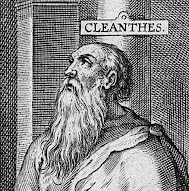
Observe: if a Stoic would pray, he would pray for greater courage, wisdom, justice and temperance.  He would pray to see the world as it really is and that his will is the same as Nature.  A Stoic would probably not pray to God for wealth and prosperity - he would not pray to God to grant him indifferents, preferred or not.  In fact, we can read Cleanthes' Hymn to Zeus and in five particular stanzas, glean correct reason.

..., Thou canst

Make the rough smooth, bring wondrous order forth

From chaos; in Thy sight unloveliness

Seems beautiful; for so Thou hast fitted things

Together, good and evil, that there reigns

One everlasting Reason in them all.


The wicked heed not this, but suffer it

To slip, to their undoing; these are they

Who, yearning ever to secure the good,

Mark not nor hear the law of God, by wise

Obedience unto which they might attain

A nobler life, with Reason harmonized.


But now, unbid, they pass on divers paths

Each his own way, yet knowing not the truth,—

Some in unlovely striving for renown,

Some bent on lawless gains, on pleasure some,

Working their own undoing, self-deceived.


O Thou most bounteous God that sittest throned

In clouds, the Lord of lightning, save mankind

From grievous ignorance!


Oh, scatter it

Far from their souls, and grant them to achieve

True knowledge, on whose might Thou dost rely

To govern all the world in righteousness;

Here is an alternate version of Hymn to Zeus (translated by Frederick C. Grant), one which I particularly like.

Therefore: in this light, we can read Seneca's Letter 60 and understand why he calls prayers for indifferents "harmful."  If others were to pray for me, then I would hope they pray to grant me more wisdom, courage, temperance and the ability to grant justice where it concerns me, but not that I get a promotion or greater wealth.  But we were born in a polluted world that desires indifferents.

Do you still desire what your nurse, your guardian, or your mother, have prayed for in your behalf? Do you not yet understand what evil they prayed for? Alas, how hostile to us are the wishes of our own folk! And they are all the more hostile in proportion as they are more completely fulfilled. It is no surprise to me, at my age, that nothing but evil attends us from our early youth; for we have grown up amid the curses invoked by our parents.

He then gets into humans' boundless desires.  We simply can't or won't check our appetites.  Yet we continue to demand of the gods for more.

How long shall we go on making demands upon the gods, as if we were still unable to support ourselves?

He notes that bulls and elephants need just a bit of land to live on and they do just fine.  But humans comb the world over for food and they delve into the sea and cast up big stores of grain.

Man, however, draws sustenance both from the earth and from the sea.  What, then? Did nature give us bellies so insatiable, when she gave us these puny bodies, that we should outdo the hugest and most voracious animals in greed? Not at all. How small is the amount which will satisfy nature? A very little will send her away contented.

Seneca seems to advocate for a simple life; one that is not dissimilar to Henry David Thoreau when he lived in the woods.  I'm not blind to the needs of people.  Much of the world still faces hunger in the year 2021 and we are still susceptible to famines.  I'm not advocating everyone live like Thoreau, but I think Seneca has a point and we can learn to live rationally and minimally without impacting the environment.  We can make mindful and informed decisions and change our behaviors.

Seneca quips about our desire for excess:

It is not the natural hunger of our bellies that costs us dear, but our solicitous cravings.  Therefore those who, as Sallust puts it, "hearken to their bellies," should be numbered among the animals, and not among men

He talks of food, but I think cravings for all kinds of indifferents applies - cravings for fame, recognition and wealth.

The Stoic aims to help - this is his social duty.

He really lives who is made use of by many; he really lives who makes use of himself.

While others, who do nothing but collect stuff are not really living and we might as well inscribe an epitaph on their fireplace mantel instead of their gravestone.

Those men, however, who creep into a hole and grow torpid are no better off in their homes than if they were in their tombs. Right there on the marble lintel of the house of such a man you may inscribe his name, for he has died before he is dead. 

Tuesday, March 23, 2021

Letters from a Stoic 59 - On Pleasure and Joy

On Pleasure and Joy

An excellent letter!  There is lots to learn and think about in this letter.

He spends the first part discussing the differences between real pleasure and real joy.  We humans often twist the meaning of words, until the original meaning is lost.  This seems to be the case with pleasure and joy.

He writes,

we Stoics hold that pleasure is a vice. Very likely it is a vice; but we are accustomed to use the word when we wish to indicate a happy state of mind.

The first lesson or reminder - pleasure is a vice.  If you need Stoic toughening, this is where to begin: by attacking areas in your life where there is indulgent pleasure.  Why else do some hug cold statues or take cold showers or sleep on the floor?  They do it to show that these things are nothing to fear.  We may fear poverty because we take pleasure in living richly.  Therefore, you should live like a pauper for some time to show yourself that it is nothing to fear - that you can live in any circumstance and still be good.  Therefore, if you find areas in your life where there is real pleasure, there may be some work and practice in that area.

Joy is lasting; it is "an elation of spirit, – of a spirit which trusts in the goodness and truth of its own possessions."

He then gives Lucilius some feedback on his writing, which I find interesting.

You have your words under control. You are not carried away by your language ... all your words are compact, and suited to the subject. You say all that you wish, and you mean still more than you say. This is a proof of the importance of your subject matter, showing that your mind, as well as your words, contains nothing superfluous or bombastic.

Many of us suffer from long-windedness or rambling.  This may be a symptom of a disordered mind.  We should pay attention to our thoughts and we should give particular focus to our inner dialogue.  Then, when you have need to write or speak, you will have control over your thoughts.  Make your point - keep it "compact" and "suited to the subject."  Too many tangents and your point is lost in the jumble.  Strive to rid the excess ... "nothing superfluous or bombastic."

He further improves this point that a well ordered and attentive mind is always ready for whatever comes, by comparing it to an army.

One of his similes appealed especially to me, that of an army marching in hollow square, in a place where the enemy might be expected to appear from any quarter, ready for battle. "This," said he, "is just what the wise man ought to do; he should have all his fighting qualities deployed on every side, so that wherever the attack threatens, there his supports may be ready to hand and may obey the captain's command without confusion."

Marcus Aurelius also used an analogy about being in an alert and ready state of mind.

The model for the application of your principles is the boxer rather than the gladiator. The gladiator puts down or takes up the sword he uses, but the boxer always has his hands and needs only to clench them into fists (Meditations 12.9).

You can only accomplish this state of mind when you pay constant attention to your inner state of mind and dialogue.  The Greek term for this is prosoche.  We moderns call it mindfulness.

Seneca continues,
the wise man is fortified against all inroads; he is alert; he will not retreat before the attack of poverty, or of sorrow, or of disgrace, or of pain. He will walk undaunted both against them and among them.
Next he discusses vice and what we must do to lessen its sway on us.
We human beings are fettered and weakened by many vices; we have wallowed in them for a long time, and it is hard for us to be cleansed. We are not merely defiled; we are dyed by them. But, to refrain from passing from one figure to another, I will raise this question, which I often consider in my own heart: why is it that folly holds us with such an insistent grasp? It is, primarily, because we do not combat it strongly enough, because we do not struggle towards salvation with all our might; secondly, because we do not put sufficient trust in the discoveries of the wise, and do not drink in their words with open hearts; we approach this great problem in too trifling a spirit.
The reason we keep our vices and follies is because:
  • we don't fight them hard enough
  • we minimize or hand-wave the words of the wise; we are complacent
He elaborates about our complacency, saying that we listen too much to those around us and are in an echo chamber and hear only the good things about ourselves.  To fight this, we have to be very skeptical of those who would dissuade us of our pursuit of philosophy.  To each person who would flatter us, we must reply:
You call me a man of sense, but I understand how many of the things which I crave are useless, and how many of the things which I desire will do me harm. I have not even the knowledge, which satiety teaches to animals, of what should be the measure of my food or my drink. I do not yet know how much I can hold.
He describes what wisdom looks like:
The wise man is joyful, happy and calm, unshaken; he lives on a plane with the gods. Now go, question yourself; if you are never downcast, if your mind is not harassed by any apprehension, through anticipation of what is to come, if day and night your soul keeps on its even and unswerving course, upright and content with itself.
If you are always joyful, happy, calm and unshaken and if you never are downcast, apprehensive and anxious about the future, but are unmoved and always choose a right and virtuous course of action and you are content with yourself, then you may be called wise.  This is the aim of philosophy!

Pleasures and vices simply distract and delay us from our aim.  He write, "These objects for which you strive so eagerly, as if they would give you happiness and pleasure, are merely causes of grief."  You think vice and pleasure will give you joy, but they actually lead to sorrow.  Furthermore, these pleasures and vices are externals - they come from without the soul.  Whereas virtue, which is the sole good, is found from within and is always up to you.  You never have to go to the bar to drink or seek validation from other people to obtain the good.  You can always have it, if you but learn.
Reflect, therefore, on this, that the effect of wisdom is a joy that is unbroken and continuous.  The mind of the wise man is like the ultra-lunar firmament; eternal calm pervades that region. You have, then, a reason for wishing to be wise, if the wise man is never deprived of joy. This joy springs only from the knowledge that you possess the virtues. None but the brave, the just, the self-restrained, can rejoice.

Wednesday, March 17, 2021

Letters from a Stoic 58 - On Being

On Being

This is a longish letter from Seneca, but he eventually makes some excellent points.  He starts off by talking about how language and words have changed and evolved over time before getting into Plato's thoughts about ideas and forms and what exists or not.  It can be a bit opaque to read, if you don't have some background of what Plato is talking about.  I've done some reading on this and reading through the first half of Seneca's letter was a bit of a struggle.  If you need a brief summary of Plato's theory of forms, see this link.

Beginning around verse 25 of the letter, Seneca writes,

"Very well," say you, "what good shall I get from all this fine reasoning?" None, if you wish me to answer your question. Nevertheless, just as an engraver rests his eyes when they have long been under a strain and are weary, and calls them from their work, and "feasts" them, as the saying is; so we at times should slacken our minds and refresh them with some sort of entertainment. But let even your entertainment be work.

In sum, Seneca went through all this as a diversion to 'slacken [his] mind' for entertainment!  After this verse, is when the letter gets better, in my opinion.

He explains why he did the analysis of the essence of things.

I try to extract and render useful some element from every field of thought, no matter how far removed it may be from philosophy. Now what could be less likely to reform character than the subjects which we have been discussing? And how can I be made a better man by the "ideas" of Plato? What can I draw from them that will put a check on my appetites? Perhaps the very thought, that all these things which minister to our senses, which arouse and excite us, are by Plato denied a place among the things that really exist.  Such things are therefore imaginary, and though they for the moment present a certain external appearance, yet they are in no case permanent or substantial; none the less, we crave them as if they were always to exist, or as if we were always to possess them (emphasis added).

What Seneca gets out of that analysis is that the very things which we think are real and exist, in fact are imaginary.  Therefore, while a Stoic may not agree or adhere to the Platonic ideas of Forms, we nonetheless can see a similarity in how we view indifferents and things that cause us to desire and crave.  Seneca applies the discipline of assent in seeing things as they really are:

We are weak, watery beings standing in the midst of unrealities; therefore let us turn our minds to the things that are everlasting. Let us look up to the ideal outlines of all things

I understand this to mean that we Stoics recognize that there is a sole good and on it we should rest our desires - namely ageless and timeless ideas such as moral virtue.  Seneca doesn't quite come out and explicitly state this in the letter, but he tends to focus more on the "defects of the body" and our impulses and "pleasures" and how we should "acquire the ability to control and check those pleasures" which ail the rest of humankind.  He advocates that we should mimic Socrates who practiced "frugal living, by setting a limit upon all that rouses the appetites, and by painstaking attention to himself."

Next he gets into his opinions about old age and when one should consider enduring old age or ending his life.

The question, therefore, on which we have to record our judgment is, whether one should shrink from extreme old age and should hasten the end artificially, instead of waiting for it to come.

It all depends on the circumstances and Seneca wants to do the right thing for the right reasons.  He writes his thoughts on the matter of extreme old age and what he thinks is the wise course of action.

I shall not abandon old age, if old age preserves me intact for myself, and intact as regards the better part of myself; but if old age begins to shatter my mind, and to pull its various faculties to pieces, if it leaves me, not life, but only the breath of life, I shall rush out of a house that is crumbling and tottering.

Here he makes it clear - as long as I have my wits about me, I'll endure living.  But if I lose my wits, I'm outta here!

I shall not avoid illness by seeking death, as long as the illness is curable and does not impede my soul.  I shall not lay violent hands upon myself just because I am in pain; for death under such circumstances is defeat.

I won't let myself off easy by killing myself to avoid the pain from a curable ailment.

But if I find out that the pain must always be endured, I shall depart, not because of the pain but because it will be a hindrance to me as regards all my reasons for living. He who dies just because he is in pain is a weakling, a coward; but he who lives merely to brave out this pain, is a fool (emphasis added).

But if he is going to endure pain that will never leave, he finds justification for ending his life.  If the pain hinders him for his reason to live, then he will depart.  We won't be a fool to bravely live out in pain.  He looks to his reason to live and if the pain prevents that, then he will go.

In sum, he will endure extreme old age, as long as he has his cognitive abilities and the pain does not prevent him from accomplishing his own reason or reasons to live (i.e. perhaps living to talk with loved ones, or writing letters to friends or something else).

Sunday, March 14, 2021

Letters from a Stoic 57 - On the Trials of Travel

On the Trials of Travel

There isn't really anything novel to me in this letter.  Seneca makes two points about fear and his musings are based on his experience while travelling, which forced him to go through a very dark and dusty tunnel.

The first point: even a person whom "fortune has lost her control" (in other words, someone who has made exceptional Stoic progress of being indifferent to circumstances), will still experience involuntary movements.  Seneca writes:

For there are certain emotions, my dear Lucilius, which no courage can avoid; nature reminds courage how perishable a thing it is. And so he will contract his brow when the prospect is forbidding, will shudder at sudden apparitions, and will become dizzy when he stands at the edge of a high precipice and looks down. This is not fear; it is a natural feeling which reason cannot rout.

This involuntary movement or emotion is described by Aulus Gellius' in The Attic Nights where a Stoic philosopher experiences the same initial emotions stemming from a raging storm.  Many Stoic authors have referred to this experience.  Donald Robertson does a good job explaining it in his essay "Epictetus: The Stoic in a Storm at Sea."

The second point from this letter: our fears can be irrational if the end result is the same.  We should overcome the fear of the result, not necessarily the thing that would cause the result.  Seneca endured the dark and dusty tunnel.  And as he saw the light at the end of the tunnel, he observed his own emotions and thoughts.

Then at the first glimpse of restored daylight my good spirits returned without forethought or command. And I began to muse and think how foolish we are to fear certain objects to a greater or less degree, since all of them end in the same way.  For what difference does it make whether a watchtower or a mountain crashes down upon us? No difference at all, you will find. Nevertheless, there will be some men who fear the latter mishap to a greater degree, though both accidents are equally deadly; so true it is that fear looks not to the effect, but to the cause of the effect. 

He then gets into the immortality of the soul and whether it remains immortal if the body gets crushed.  Indeed, this part of the letter gets a bit metaphysical, but if you recall Stoic physics and how we are all part of the same Cosmos, one could argue the soul indeed is immortal. Seneca thinks the mind is composed of “rarefied material” and therefore can survive the body being crushed and remain immortal.  While this idea may represent a minatory of Stoics, we can still fall on the undisputed fact that the Stoics believed the Cosmos exists through endless cycles of existence, through the ekpyrosis and then re-emerging again. In this case, the soul lives again.

Tuesday, March 9, 2021

Letters from a Stoic 56 - On Quiet and Study

On Quiet and Study

The sum total of this letter to Lucilius is found in this quote:

what benefit is a quiet neighbourhood, if our emotions are in an uproar?

By the time you get to the end of the letter, you see the full picture.  Seneca purposely moved to and lived in a raucous part of the city to test himself to see if his mind could be at peace amid all the noise.  He wanted to know if he could tune out the noise and still be able to maintain his equanimity.

You may therefore be sure that you are at peace with yourself, when no noise reaches you, when no word shakes you out of yourself, whether it be of flattery or of threat, or merely an empty sound buzzing about you with unmeaning din.  "What then?" you say, "is it not sometimes a simpler matter just to avoid the uproar?" I admit this. Accordingly, I shall change from my present quarters. I merely wished to test myself and to give myself practice.

The rest of the letter is a list of things that cause him and others distraction.  The noises of the street to other peoples' words; from constant to intermittent noises.  If he can master keeping a tranquil mind with all the external noises, he can more fully comprehend how to quiet the disturbances within.

I force my mind to concentrate, and keep it from straying to things outside itself; all outdoors may be bedlam, provided that there is no disturbance within, provided that fear is not wrangling with desire in my breast, provided that meanness and lavishness are not at odds, one harassing the other. 

And if all the noises have been managed and you are left with a dead-quiet home and life and yet you are still disturbed, then you have need for further work.

For even when we seek slumber, our sleepless moments are as harassing as the daytime. Real tranquility is the state reached by an unperverted mind when it is relaxed ... You need not suppose that the soul is at peace when the body is still. Sometimes quiet means disquiet.

One potential solution to address disquietude is to keep our minds busy with good interests.  As Proverbs 16:7 mentions, idle hands (and mind) are a devil's workshop.

We must therefore rouse ourselves to action and busy ourselves with interests that are good, as often as we are in the grasp of an uncontrollable sluggishness.  Great generals, when they see that their men are mutinous, check them by some sort of labour or keep them busy with small forays. The much occupied man has no time for wantonness, and it is an obvious commonplace that the evils of leisure can be shaken off by hard work.

In sum, stay busy with good interests; don't let the external raucous disturb you with the goal of having a tranquil mind whether in loud or quiet settings.

Tuesday, March 2, 2021

Letters from a Stoic 55 - On Vatia's Villa

On Vatia's Villa

The human mind is incredible.  As a child, I would day dream so much, my teachers were always trying to get my attention back into the classroom.  One of my favorite things to do was to sit on the floor in my bedroom and play with my toys - imaging the small figurines and cars were armies or football teams fighting against each other.  But over the years, I've been disciplined by teachers and the demands of school and work to focus on the here and now.  I will admit, that frequently (especially at 2pm on most days) my mind drifts off in contemplation.

What does this have to do with Seneca's letter about Vatia's Villa?  It's this unique ability of the human mind to give itself an instant vacation while at work and engaged in society.  We do not need a villa to escape.  We can practice instantaneous escape and then snap right back into the present moment.

Before making this point, Seneca commentates a bit about luxuries and how they make us weak.

Nature gave us legs with which to do our own walking, and eyes with which to do our own seeing. Our luxuries have condemned us to weakness; we have ceased to be able to do that which we have long declined to do.

If this were true for Seneca's time, it is truer still today in the year 2021.  I recently read a comment on-line where a person said that it has never been easier to be strong, than now.  Everyone is weak and with a little effort, you can appear strong.

Back to Vatia and his village.  Seneca notes,

people used to cry out: "O Vatia, you alone know how to live!"  But what he knew was how to hide, not how to live; and it makes a great deal of difference whether your life be one of leisure or one of idleness.

To me, it sounds like Seneca is saying Vatia does not have a meaningful life and all he is doing is hiding out in his villa.  His life is not one of leisure, but of idleness.

He goes on,

the mass of mankind consider that a person is at leisure who has withdrawn from society, is free from care, self-sufficient, and lives for himself;

Seneca begins to make the point here.  You do not need to withdraw from society in a villa or in the mountains to be at leisure.  Rather, you you can achieve leisure in your mind alone.

The person who hides from society does not know how to live.  You must learn how to live in order to learn how to attain leisure.  Therefore, the person who shuts himself off from the world does not know how to live nor does he know leisure.

Does he even know (and that is of first importance) how to live at all?  For the man who has fled from affairs and from men, who has been banished to seclusion by the unhappiness which his own desires have brought upon him, who cannot see his neighbour more happy than himself, who through fear has taken to concealment, like a frightened and sluggish animal, – this person is not living for himself; he is living for his belly, his sleep, and his lust, – and that is the most shameful thing in the world.

Therefore, we now know that the place you are at or where you live cannot bring fulfillment.  If you are always wanting to be somewhere else, then you will always be malcontented.  You fail to fix the very thing you take with you no matter where you go!

The place where one lives, however, can contribute little towards tranquillity; it is the mind which must make everything agreeable to itself. I have seen men despondent in a gay and lovely villa, and I have seen them to all appearance full of business in the midst of a solitude. For this reason you should not refuse to believe that your life is well-placed merely because you are not now in Campania.

The trick - the lesson - is to learn to be content where you are at, no matter where you are.  If you can do this, then you can allow yourself the freedom and leisure to drift off to the villa for a moment of respite.  This is what wise men do.

If you develop this ability, you may also develop the ability to converse with people who are not now with you.  You will always have a friend with you if you can think on them and talk with them in your mind.

You may hold converse with your friends when they are absent, and indeed as often as you wish and for as long as you wish.

This is precisely what Seneca and Lucilius are attempting to do.  While they are not corresponding in letters, they are advising each other - in a sense, they are living in each other's heads.

Tuesday, February 23, 2021

Letters from a Stoic 54 - On Asthma and Death

On Asthma and Death

Seneca suffers from asthma and according to what he says, physicians of the day called asthma "practicing how to die" - which some have also called philosophy!

He notes it would be 

absurd to take delight in such supposed restoration to health, as it would be for a defendant to imagine that he had won his case when he had succeeded in postponing his trial.

Rather than taking delight that he's overcome a bout with asthma, Seneca reassures Lucilius that he has "never ceased to rest secure in cheerful and brave thoughts."  He has long pondered the before and after of living, and arrived at the conclusion he's already lived death before he was born!

would you not say that one was the greatest of fools who believed that a lamp was worse off when it was extinguished than before it was lighted? We mortals also are lighted and extinguished; the period of suffering comes in between, but on either side there is a deep peace. ... it has both preceded us and will in turn follow us.

Let me pull on this thread a bit more, because this metaphysical idea is worth contemplating. In this analogy, the lamp always exists, regardless if it were lit or unlit. The fact that the lamp is always there, would be similar to stating that you – your essence and even your body – always exists as long as the cosmos exists. Before the lamp is lit, your essence and your body are not manifested. But then you come into existence – the lamp is lit. Eventually, the lamp will be blown out, but it will be lit again. Metaphysically speaking, the Stoics believe in the ekpyrosis (see definition in lexicon) or the notion that the Cosmos experiences a period of destruction and exists as pure fire, before it returns again to what it was before, in which the pure fire, or pneuma is mixed the elements. Given this context, death is nothing be a pause between existence and therefore is nothing to fear. And because he has spent time contemplating death, he claims he is ready for it and won't be frightened when it comes and will go willingly.

Thursday, February 18, 2021

Letters from a Stoic 53 - On the Faults of the Spirit

On the Faults of the Spirit

It seems that Seneca was persuaded to take a trip across the sea; against his better judgement.  They set off in fair weather, but when they were out a ways, a terrible storm set in and gave him terrible sea-sickness.  He begged the captain to get to shore, but the captain would not because of the danger.

But I was suffering too grievously to think of the danger, since a sluggish seasickness which brought no relief was racking me, the sort that upsets the liver without clearing it. Therefore I laid down the law to my pilot, forcing him to make for the shore.

As they approached the coast, he could not wait to be on land, and so he threw himself into the sea, and emerged into the cold water and scrambled onto the rocks!  I can only imagine the physical suffering for Seneca was so great, he was willing to sacrifice life and limb to get relief!

After he settled a bit, he reflected 

how completely we forget or ignore our failings, even those that affect the body, which are continually reminding us of their existence, – not to mention those which are more serious in proportion as they are more hidden.

It seems he knew that he would react this way before going on the sea trip, but yet he forgot, dismissed or minimized his "failings" of his body.  He compares these hidden physical failings to our own moral failings.  If we seem to forget or minimize our physical failings, how much more are we apt to forget or minimize our moral deficiencies.

Why will no man confess his faults? Because he is still in their grasp; only he who is awake can recount his dream, and similarly a confession of sin is a proof of sound mind.

Our solution?  Philosophy.  It will crack the whip on our moral failings and it will demand we address them.  We need to give proper heed to her counsel.

Philosophy, however, is the only power that can stir us, the only power that can shake off our deep slumber. Devote yourself wholly to philosophy. You are worthy of her; she is worthy of you; greet one another with a loving embrace. Say farewell to all other interests with courage and frankness. Do not study philosophy merely during your spare time.

He compares the urgency of studying philosophy to that of healing yourself if you were physically ill.

If you were ill, you would stop caring for your personal concerns, and forget your business duties; you would not think highly enough of any client to take active charge of his case during a slight abatement of your sufferings. You would try your hardest to be rid of the illness as soon as possible. What, then? Shall you not do the same thing now?

This comparison underscores an important observation: the fact that many of us, who are not sages, value our physical nature above our rational.  We would drop all our activities if we were sick, but we don't give the same urgency to our moral illnesses.  If we were convinced, individually and as a civilization, that our rational nature is of the utmost importance, many of our policies and dialogues might be different.  Despite that, we still can make inroads into correcting our moral failings, and therefore, we should give more of our time to the study and practice of philosophy.

She is not a thing to be followed at odd times, but a subject for daily practice; she is mistress, and she commands our attendance. ... Turn to her, therefore, with all your soul, sit at her feet, cherish her; a great distance will then begin to separate you from other men.

This is something in our control - how we prioritize our study and practice of philosophy.